If you have ever attempted to plan a major home renovation, calculate an early mortgage amortization payoff, or verify a scientific unit conversion online, you know the frustration of calculator fragmentation. One website gives you a mortgage estimate but hides its amortization schedule assumptions; another estimates concrete volume in cubic yards without calculating how many 80-lb pre-mix bags you must purchase at the home improvement store; a third bombards your screen with intrusive layout-shifting video ads while quietly harvesting your financial figures into marketing tracking databases.
The modern computational web is undergoing a major paradigm shift. Serious homeowners, contractors, quantitative analysts, and everyday consumers are abandoning scattered, ad-choked single-utility pages in favor of client-side Universal Calculator Hubs. This comprehensive guide explores the architectural, mathematical, and practical reasons why unified calculation hubs represent the future of web utility.
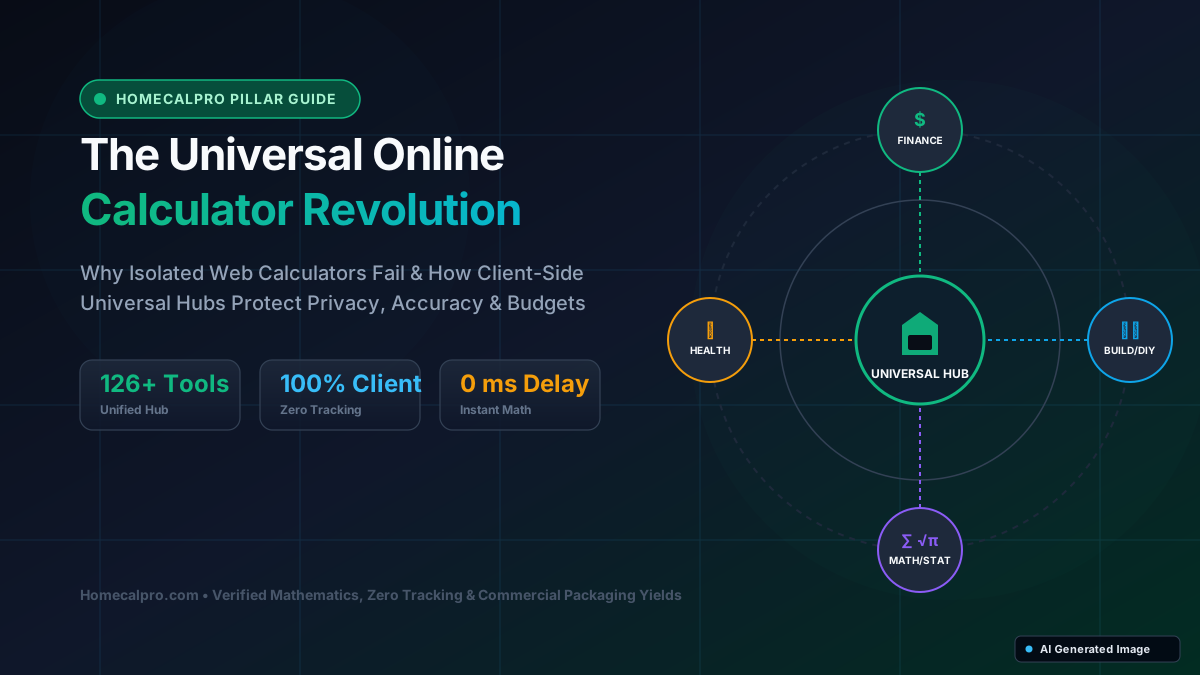
Quick answer:A Universal Online Calculator Hub consolidates dozens of fragmented single-niche tools into one standardized, high-speed ecosystem. Unlike legacy web calculators that send your personal financial figures or project dimensions to remote ad servers, modern universal hubs execute 100% of mathematical algorithms locally in your browser memory (0 ms latency), publish transparent algebraic equations, and calculate realistic commercial retail packaging units with verified scrap buffers.
1. The 4 Fundamental Flaws of Fragmented 2010s-Era Online Calculators
To understand why universal hubs have become indispensable, it helps to examine what went wrong with the legacy utility web over the past fifteen years. Between 2010 and 2022, thousands of microsites were launched targeting hyper-specific keywords like 'fence calculator' or 'car loan payment tool'. While well-intentioned, this distributed model introduced four severe systemic flaws for everyday users.
First, privacy exploitation became the de facto monetization strategy. When you enter your household gross income, credit card debts, and proposed loan balance into a generic financial calculator, that sensitive data is frequently serialized into analytics pixels and sold to lead-generation brokers. Second, intrusive ad technology destroyed usability. Third-party ad networks inject bloated JavaScript trackers that cause severe Cumulative Layout Shift (CLS), moving input fields while you type and triggering accidental ad clicks.
Third, legacy calculators rely on opaque 'black-box' mathematics. Rarely do they display the raw algebraic formulas, interest compounding conventions (e.g. 30/360 vs Actual/365), or waste buffer calculations behind their results. Users are forced to blindly accept a number without knowing if cutting scrap or aggregate settling was accounted for.
Finally, legacy calculators operate in pure theoretical units rather than practical commercial retail reality. Knowing that your living room floor requires 384.2 net square feet of laminate is useless if you cannot compute that the manufacturer packages 21.5 square feet per carton and that your installer requires an 8% waste allowance.
The Black-Box Risk
An unverified calculator that miscalculates loan compounding by even 0.25% or overlooks retail packaging scrap buffers can cost homeowners thousands of dollars in excess borrowing costs or multiple wasted trips to the supply yard.
2. The Technical Anatomy of a Client-Side Universal Calculation Hub
A modern Universal Calculator Hub is fundamentally different from a collection of standalone web scripts. Rather than relying on cloud server roundtrips, it operates as an edge-delivered, static web application executing 100% of its computational algorithms directly within your browser's V8 or JavaScriptCore virtual machine.
This architecture delivers three decisive technological advantages:
- Zero-Latency Computation (0 ms Delay): Because mathematical expressions evaluate in client RAM, results update instantly on every keystroke or slider movement, eliminating loading spinners and frustrating screen refreshes.
- Complete Zero-Knowledge Privacy: Your financial entries, room dimensions, debt obligations, and health metrics are processed solely in temporary memory and never transmitted over network sockets or saved in server databases.
- Deterministic Formula Transparency: Codebases built on modern open standards document their algebraic equations openly, allowing users to audit variable definitions, constants, and rounding rules step-by-step.
3. Comparative Matrix: Legacy Single-Purpose Calculators vs. Universal Hubs
The table below illustrates the structural differences between legacy, ad-driven single-tool websites and a verified, client-side Universal Calculator Hub like Homecalpro:
| Evaluation Dimension | Legacy Fragmented Calculator | Modern Universal Calculator Hub (Homecalpro) |
|---|---|---|
| Computation Engine | Server-side request / Slow PHP or cloud function | 100% Client-side JavaScript in local browser memory |
| Calculation Latency | 300 ms – 2,500 ms roundtrip delay | Sub-1 ms instant reactive response on keypress / Enter |
| Data Privacy & Security | Inputs tracked, stored & shared with ad networks | Zero tracking, zero database writes, 100% in-browser RAM |
| Mathematical Transparency | Opaque black box (formula hidden behind paywalls) | Open algebraic formulas & step-by-step worked proofs |
| Retail Packaging Logic | Raw fractional decimals only (e.g. 2.37 cu yds) | Translates volume to retail units (e.g. 107 80-lb pre-mix bags) |
| Cross-Tool Consistency | Inconsistent UI, random unit systems, conflicting math | Standardized design system, uniform keyboard navigation, dual units |
| User Experience | Cluttered popups, video auto-play, severe CLS | Clean, ad-light, high-contrast Day/Night themes, 0 CLS |
4. Worked Scenario: The Power of Multi-Domain Calculation in Real Life
Consider a typical homeowner planning a $20,000 backyard improvement project involving a new concrete patio slab, perimeter cedar privacy fence, and financing the material costs through an unsecured home improvement loan.
Under the legacy model, this homeowner must visit three entirely separate websites with conflicting unit systems, uncalibrated waste assumptions, and distinct ad trackers. On a Universal Calculator Hub, the entire project scopes harmoniously:
Fixed-Rate Amortization Equation
Monthly Payment M = P × [r(1 + r)^n] / [(1 + r)^n - 1], where P = principal, r = monthly interest rate (annual / 12), and n = total monthly repayment periods.
- Concrete Slab Scoping: The Home Improvement estimator determines that a 12 ft × 16 ft × 4 in patio slab requires 2.37 cubic yards of concrete, factors in a 10% subgrade compaction buffer (2.61 cu yds total), and translates that into exactly 118 bags of 80-lb dry pre-mix concrete (or 2.75 cubic yards of ready-mix truck delivery).
- Fence Framing Takeoff: The Fence calculator calculates 14 posts set at 8-foot on-center intervals, 28 horizontal 2x4 rails, 28 bags of fast-setting concrete for 24-inch post holes, and 224 cedar pickets including a 5% trimming scrap allowance.
- Financial Amortization: The Loan calculator models the $20,000 balance at 7.5% over 36 months, proving that paying $622.13 monthly yields a total interest cost of $2,396.68, while rounding payments up to $700.00 pays the project off 4 months early and saves $287 in financing interest.
5. Five Criteria to Verify Any Online Calculator Before Relying on Its Output
Whether you use Homecalpro or another online computation tool, verify that the application satisfies these five objective quality criteria before relying on its numbers for major financial commitments or material orders:
- 1. Inspect Formula Availability: Does the site publish the raw mathematical equation, variable definitions, and worked algebraic examples? If the math is concealed, treat the estimate with caution.
- 2. Verify Waste Allowances: For physical construction materials (concrete, tile, lumber, drywall, roofing), does the algorithm allow customized cutting waste buffers (5% to 15%) to prevent project shortfalls?
- 3. Check Retail Packaging Output: Does the tool provide whole purchase quantities (e.g. cartons, bundles, gallons, bags) or does it merely leave you with an unhelpful cubic yard or raw square footage decimal?
- 4. Confirm Client-Side Execution: Disconnect your internet connection or switch to airplane mode after loading the page. A high-quality tool continues computing instantly in local memory because the math engine is purely client-side.
- 5. Demand Keyboard Accessibility: Can you navigate between fields using the Tab key and recalculate instantly by pressing Enter? Serious professional tools prioritize rapid keyboard interaction over clunky button clicks.
Frequently Asked Questions
Click any question below to expand quick answers, formulas, and expert tips.
What is a Universal Online Calculator Hub?
A Universal Online Calculator Hub is a unified, high-performance web platform that consolidates specialized calculation tools across multiple domains (Finance, Construction, Math, Science, Health, and Daily Utilities) into a single cohesive interface, standardizing mathematical precision, privacy, and user experience.
Why is client-side calculation safer than cloud-based calculators?
Client-side calculators execute mathematical algorithms exclusively inside your browser's local RAM. Your financial figures, loan balances, salary records, and project measurements are never sent over the internet or saved to remote databases, providing 100% zero-knowledge data privacy.
How do universal material calculators calculate retail unit buffers?
Our estimators use geometric volume equations multiplied by standardized material densities, then apply verified scrap buffers (typically 5% to 15% depending on room complexity) before dividing by commercial packaging standards (such as 80-lb concrete bags, 20 sq ft flooring boxes, or 33.3 sq ft roofing bundles) and rounding up to the nearest whole purchase unit.
Why do different online calculators give different results for the same problem?
Discrepancies usually stem from three factors: differing interest compounding conventions (e.g. 30/360 vs Actual/365 in loans), unstated scrap buffers, or arbitrary rounding rules. Homecalpro solves this by publishing open, standard-calibrated formulas matching NIST, IRC, ACI, and federal Truth in Lending benchmarks.
The Bottom Line
Online calculation should empower users to make confident decisions without compromising privacy, wrestling with layout-shifting popups, or guessing about opaque black-box math. By combining transparent formulas, instant client-side execution, and practical commercial packaging units into a single cohesive home, Homecalpro establishes a modern, trusted benchmark for web calculation. Explore our full directory of 126+ specialized tools today.
This article is for informational and educational purposes. Always verify complex calculations with a qualified professional or official documentation.