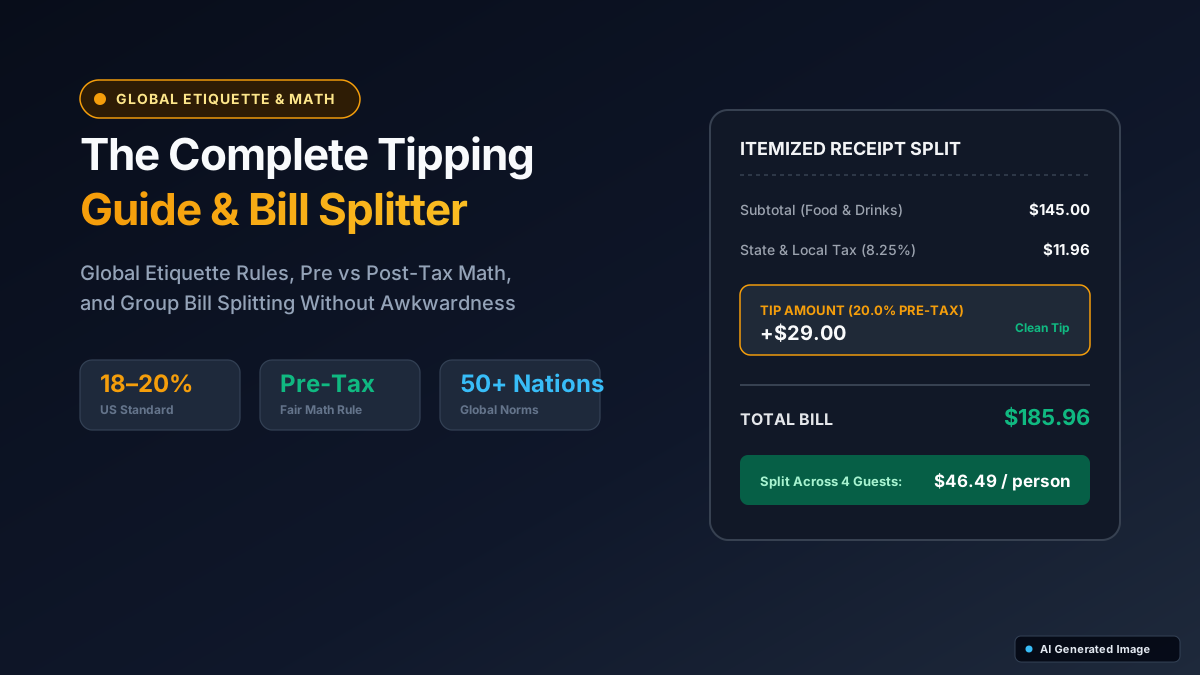
Every single month, more than 1.8 million people type queries like 'tip calculator', 'how much to tip on $100', 'do you tip before or after tax', or 'tipping in Canada vs US' into search engines. What used to be a straightforward gesture of appreciation for restaurant servers has evolved into one of the most confusing, socially fraught, and economically debated financial transactions in everyday life.
The rapid proliferation of digital point-of-sale touchscreens at coffee shops, convenience stores, and counter-service bakeries—often prompting for 20%, 25%, or even 30% gratuity before an item is handed over—has created widespread 'tip fatigue'. At the same time, food delivery apps, rideshare services, and international travel have introduced complex layers of etiquette where what is considered generous in New York or Toronto might be considered insulting in Tokyo or redundant in Sydney.
This comprehensive, research-backed guide breaks down everything you need to know about tipping math, search patterns, etiquette benchmarks, group bill splitting, and the specific cultural and legal rules governing gratuities across major Tier-1 economies worldwide.
Quick answer:In the United States and Canada, the standard sit-down restaurant tip is 15% to 20% calculated on the pre-tax food and beverage subtotal. In the UK, 10% to 12.5% is customary if a discretionary service charge is not already included. In Australia and New Zealand, tipping is optional due to higher base wages, while in Germany and France, rounding up by 5% to 10% or leaving small change is customary. In Japan, tipping is culturally discouraged and viewed as unnecessary.
Why 'Tip Calculator' Is One of Google's Most Searched Everyday Math Terms
Search volume for tip calculators and gratuity guides spikes consistently during Friday and Saturday dinner hours, major holiday seasons (Thanksgiving, Christmas, New Year's Eve), and international travel peaks (summer vacation periods). But why do millions of adults seek digital help for what seems like a simple percentage calculation?
The answer lies in the intersection of mathematical uncertainty, social etiquette anxiety, and structural changes in how businesses collect payments. Diners rarely want to pull out a standard calculator and punch in complicated formulas while servers hover nearby or companions wait to settle the check. More importantly, people search not just for the raw arithmetic, but for validation: *What is the socially accepted standard for this specific situation?*
Over the past few years, the nature of these searches has shifted from simple percentages (e.g., '15 percent of 80 dollars') toward nuanced situational rules, pre-tax versus post-tax fairness, split-bill equity, and international customs.
How Real People Search for Tipping Guidance on Google (The 5 Core Search Intent Types)
Analyzing search engine queries reveals that people looking for tipping information fall into five distinct categories of intent. Understanding these query patterns illustrates the diverse practical dilemmas consumers face every day:
- 1. Exact Dollar Calculation Queries: 'how much is 20 percent tip on $85.50', 'what is 18% tip on $120 bill', 'tip on $50 food delivery'. These users have a specific receipt in front of them and need an immediate, trustworthy dollar figure without mental math friction.
- 2. Accounting & Base Calculation Inquiries: 'do you calculate tip before or after sales tax', 'should you tip on alcohol tax', 'is service charge the same as a tip', 'difference between auto-gratuity and tip'. These searchers are questioning whether POS machines are inflating the tip base unfairly.
- 3. Situational Etiquette Dilemmas: 'do you tip on pickup takeout orders', 'how much to tip hair stylist on expensive $300 color', 'tipping Uber driver at the airport with luggage', 'how much to tip hotel housekeeping per night in cash', 'do you tip furniture delivery drivers'. These users know how to do math but don't know the social norms for non-restaurant services.
- 4. Group Dynamics & Fair Bill Splitting: 'split bill tip calculator for 4 people', 'how to split restaurant bill when one person didn't drink alcohol', 'how to calculate tip when sharing appetizers'. Group dining often causes friction when some guests order $15 burgers while others order $45 steaks and cocktails.
- 5. Cross-Border & International Travel Lookups: 'how much to tip in Canada vs US', 'do you tip in UK pubs when ordering at the bar', 'tipping etiquette in Australia for American tourists', 'why do Japanese restaurants refuse tips', 'tipping in Paris cafes etiquette'. International travelers want to avoid cultural embarrassment or accidental overpaying.
The Great Debate: Pre-Tax vs. Post-Tax Tipping (With Mathematical Proof)
One of the most contentious questions in consumer finance is whether a tip should be calculated on the **pre-tax subtotal** (food and beverages only) or the **post-tax grand total** (subtotal plus local sales taxes, alcohol taxes, and municipal levies).
According to traditional etiquette authorities (such as the Emily Post Institute) and financial consumer advocates, **gratuity should always be calculated on the pre-tax food and beverage subtotal**. Sales tax is a compulsory government revenue assessment, not a service provided by the restaurant staff. Tipping on top of tax is effectively paying a tax on a tax.
However, modern digital Point-of-Sale (POS) systems (including Toast, Square, and Clover) routinely default their recommended tip buttons (18%, 20%, 22%) to the **post-tax grand total**. In high-tax jurisdictions—such as New York City (8.875%), Chicago (10.25%), or parts of California (up to 10.75%)—this subtle adjustment inflates the tip by an extra 1.5% to 2.5% of the overall bill.
Financial Impact of Pre-Tax vs Post-Tax
For an average household dining out twice a week with an annual restaurant spend of $7,500 in a 9% tax jurisdiction, calculating tips on the pre-tax subtotal saves between $135 and $270 per year—without reducing the fair percentage earned by the server on their actual labor.
| Food & Drink Subtotal | Sales Tax Rate | Post-Tax Total | Pre-Tax 20% Tip | Post-Tax 20% Tip (POS Default) | Difference Overpaid |
|---|---|---|---|---|---|
| $50.00 | 8.00% ($4.00) | $54.00 | $10.00 | $10.80 | +$0.80 (+8.0%) |
| $100.00 | 8.875% ($8.88) | $108.88 | $20.00 | $21.78 | +$1.78 (+8.9%) |
| $150.00 | 10.00% ($15.00) | $165.00 | $30.00 | $33.00 | +$3.00 (+10.0%) |
| $250.00 | 9.50% ($23.75) | $273.75 | $50.00 | $54.75 | +$4.75 (+9.5%) |
| $500.00 | 10.25% ($51.25) | $551.25 | $100.00 | $110.25 | +$10.25 (+10.2%) |
Global Tipping Standards: A Country-by-Country Breakdown for Tier-1 Nations
Tipping etiquette varies dramatically across Tier-1 countries due to differences in labor legislation, minimum wage models, tax structures, and cultural expectations. What is an essential living wage supplement in North America may be redundant in Australia or culturally offensive in Japan.
- United States: Tipping is a deeply embedded economic expectation in full-service dining. Under US federal law, the 'tipped minimum wage' has been frozen at $2.13/hour since 1991 (though several states like California, Washington, Oregon, and Nevada require full state minimum wage before tips). Standard dining tips are 15% (adequate service), 18% to 20% (standard/good service), and 22%+ (outstanding service). Tipping is also customary for bartenders ($1-$2/drink), food delivery ($3-$7 depending on distance), hair stylists (15-20%), and valet parking ($3-$5).
- Canada: Canadian tipping culture closely mirrors the United States, with typical restaurant tips ranging from 15% to 20%. However, most Canadian provinces (including Ontario, British Columbia, and Alberta) have eliminated lower 'liquor server' minimum wages, ensuring restaurant workers earn the same statutory minimum wage (often $16.55 to $17.40+ CAD) as other industries. GST/HST taxes are not tipped upon by knowledgeable consumers.
- United Kingdom: In sit-down restaurants, a tip of 10% to 12.5% is customary. However, most London and major city restaurants automatically add an 'optional discretionary service charge' of 12.5% to the bill. If this charge is already included, no additional tip is needed. Under the UK's Employment (Allocation of Tips) Act 2024, employers are legally prohibited from withholding any portion of tips or service charges from staff. In traditional British pubs, you order and pay at the bar; leaving a tip is NOT customary, though offering to 'buy the bartender a half-pint' is an old-fashioned token of appreciation.
- Australia: Tipping is strictly voluntary and not part of everyday Australian life. Australian hospitality staff are protected by the Modern Award system, earning high base minimum wages ($24.10+ AUD per hour) with mandatory penalty rates on weekends, public holidays, and late shifts (often $30-$45/hr). In casual cafes, pubs, and family diners, tipping is rare. In upscale fine dining, diners may round up the bill or leave 5% to 10% for truly exceptional service. Automated 15-20% tablet prompts in Australian coffee shops face heavy consumer resistance.
- New Zealand: Similar to Australia, New Zealand operates on a strong statutory minimum wage system. Tipping is not customary or expected in cafes, bars, or restaurants. While tips are appreciated if left for exceptional service, servers never expect gratuities, and bills never include suggested tipping percentages.
- Germany & Austria: Service is legally included (*Bedienung inbegriffen*), but rounding up the bill (*Trinkgeld*) is customary. Rather than leaving coins on the table, customers state their total including tip to the server while paying. For example, if a bill is €44.20, a customer might hand over a €50 note and say 'Stimmt so' (keep the change) or say 'Siebenundvierzig' (€47.00), leaving a 5% to 10% tip.
- France: French law requires all restaurant and cafe bills to include a 15% service charge (*Service Compris*), which is already baked into the printed menu prices. Waiters earn full living wages and national healthcare benefits. Leaving a small *pourboire* (literally 'for drinking') of €1 to €2 for casual meals or €5 to €10 for fine dining in cash on the table is an optional gesture of genuine gratitude.
- Japan: Tipping is strictly non-existent across restaurants, taxis, hotels, and personal services. Japanese hospitality is rooted in the philosophy of *Omotenashi*—providing flawless, thoughtful service as a matter of professional pride without expecting supplemental compensation. Leaving extra money on a table or handing cash to a server can cause confusion, embarrassment, or lead staff to chase you down the street to return your 'forgotten' change.
Global Tipping Comparison Table for Major Economies
Here is a quick-reference summary of tipping norms, legal wage context, and recommended percentages across primary Tier-1 travel and economic destinations:
| Country / Region | Sit-Down Restaurant Norm | Base Hospitality Wage Context | Food Delivery / Taxi | Pubs / Counter Service | Cultural Expectation |
|---|---|---|---|---|---|
| United States | 18% – 22% (Pre-Tax) | Federal tipped wage $2.13/hr (varies by state) | $3 – $7 / 15% – 20% | $1 – $2 per drink; 0% – 10% counter | Mandatory social expectation; primary server income. |
| Canada | 15% – 20% (Pre-Tax) | Full provincial minimum wage ($16 – $17.50+ CAD) | 10% – 15% ($3 – $5 CAD) | $1 per drink; optional counter | Expected in full-service dining; pushback on counter tablets. |
| United Kingdom | 10% – 12.5% (Discretionary) | National Living Wage (£11.44+/hr) | £1 – £3 / 10% | No tipping at pub bar; £0 counter | Discretionary; check if 12.5% service charge is already on bill. |
| Australia | Optional (0% – 10% fine dining) | High Award wage ($24.10+ AUD + weekend penalty) | Optional ($2 – $5 AUD) | No tipping in pubs or cafes | Not customary; workers are paid fair living wages by employers. |
| New Zealand | Optional (0% – 10%) | High statutory minimum wage ($23.15+ NZD) | Optional ($2 – $4 NZD) | No tipping customary | Not expected; rounding up occasional in fine dining. |
| Germany / Austria | 5% – 10% (Round up) | Statutory minimum wage (€12.82+/hr) | €1 – €3 round up | Round up change directly to server | Customary to state rounded total ('Stimmt so') to server. |
| France | Optional small change (€1 – €3) | Service Compris (15% included in menu by law) | €1 – €2 round up | No tipping at counters or bars | Service is legally included; small cash pourboire appreciated. |
| Japan | 0% (Strictly No Tipping) | Standard hourly wage + full benefits | 0% (No tip) | 0% (No tip) | Culturally discouraged; seen as insulting or confusing. |
Service Industry Tipping Benchmarks: Who, When, and How Much
Outside of restaurants, tipping standards vary widely across everyday personal care, hospitality, transportation, and home delivery services. Here is an industry-standard benchmark for the United States and Canada:
| Service Professional | Standard Gratuity Benchmark | Calculation Basis | Practical Etiquette & Notes |
|---|---|---|---|
| Food Delivery (DoorDash, Uber Eats) | $3.00 – $5.00 minimum, or 15% – 20% | Distance + weather + order size | Tip more for long distances (>5 miles), heavy rain/snow, or steep stair walk-ups. |
| Bartender | $1.00 – $2.00 per drink, or 18% – 20% on tab | Per-drink or total bar tab | Tip $2 for labor-intensive craft cocktails; $1 for simple bottled beer or wine pours. |
| Coffee Barista | $0.00 (optional) to $1.00 / change | Loose change or $1 for complex drinks | Not obligatory for simple drip coffee or pastry grab-and-go. |
| Hair Stylist / Barber | 15% – 20% of service cost | Total service fee before product purchases | Tip the shampoo assistant $3 – $5 separately if they are not tipped out by the stylist. |
| Rideshare (Uber, Lyft, Taxi) | 10% – 20% ($2.00 – $5.00 minimum) | Ride fare + luggage assistance | Add $1 – $2 per heavy bag handled by the driver at airports or train stations. |
| Hotel Housekeeping | $3.00 – $5.00 per night | Cash left daily in marked envelope | Leave cash daily rather than a lump sum at checkout, as cleaning staff rotate shifts. |
| Hotel Valet / Bellhop | $2.00 – $5.00 per vehicle / $1 – $2 per bag | Per retrieval or per luggage item | Tip valet upon vehicle retrieval; tip bellhops when luggage is brought to the room. |
| Massage / Esthetician | 15% – 20% of standard rate | Non-discounted service price | Calculate tip on the full regular price even if you used a Groupon or discount code. |
| Movers & Heavy Furniture Delivery | $20.00 – $50.00 per worker | Flat cash based on hours & stairs | Provide cold bottled water and snacks; tip on the higher end for multi-flight staircases. |
How to Split Group Dining Bills Fairly (Formulas & Edge Cases)
Splitting a restaurant check among friends, coworkers, or family is one of the quickest ways to create social friction. There are two primary mathematical approaches to splitting a group bill:
When orders vary widely in price, an even split penalizes light eaters and non-drinkers. To calculate a fair proportional split for individual diners without complex accounting, use the Proportional Multiplier Method:
The Proportional Bill Splitting Formula
Individual Total = Personal Items Subtotal × (1 + Tax Rate + Desired Tip Rate). For example, with an 8% sales tax and a 20% tip, the multiplier is (1 + 0.08 + 0.20) = 1.28. Multiply each person's food/drink items by 1.28 to allocate exact tax and tip in a single calculation.
- Method 1: The Even Split (Total Bill ÷ Number of People). Best used when all diners ordered comparable meals, shared multiple appetizers, and drank similar amounts of alcohol. It is fast, simple, and requires zero line-by-line receipt auditing.
- Method 2: The Proportional Itemized Split. Essential when there are large disparities in orders—such as one person ordering a $16 salad with tap water while another orders a $64 steak and premium wine.
| Diner | Items Ordered | Raw Subtotal | Proportional Tax (8%) | Proportional Tip (20%) | Fair Individual Total |
|---|---|---|---|---|---|
| Diner A (Light) | Caesar Salad & Iced Tea | $16.00 | $1.28 | $3.20 | $20.48 |
| Diner B (Moderate) | Chicken Parmesan & Soda | $26.00 | $2.08 | $5.20 | $33.28 |
| Diner C (Cocktails) | Burger, Fries & 2 Cocktails | $44.00 | $3.52 | $8.80 | $56.32 |
| Diner D (Steak & Wine) | Ribeye Steak & Glass of Pinot | $64.00 | $5.12 | $12.80 | $81.92 |
| Total Group Bill | All 4 Diners Combined | $150.00 | $12.00 | $30.00 | $192.00 |
Navigating 'Tip Fatigue' and Point-of-Sale Tablet Guilt
If you have felt uncomfortable when a cashier spins an iPad screen toward you displaying 20%, 25%, and 30% tip options for a $4.50 black coffee or a grab-and-go muffin, you are experiencing **tip fatigue** (often dubbed *tipflation* or *tip creep*).
Digital POS terminals are deliberately programmed by software vendors and merchant processors to prompt for gratuity because payment processors take a 2.5% to 3.5% transaction fee on the entire transaction—including the tip. Furthermore, pre-selected tip prompts exploit social pressure and urgency.
Here is the practical, guilt-free etiquette framework for handling modern touchscreen prompts:
- 1. Distinguish Service vs. Transaction: A tip is compensation for attentive table service, custom drink preparation, or delivery labor. Handing you a pre-packaged bottle of water from a cooler is a basic retail transaction, not a tipped service.
- 2. The 3-Second Rule for Counter Service: It is 100% socially acceptable to press 'No Tip' or 'Custom $1.00' for counter-service purchases, bakery pickups, and self-serve kiosks. You do not owe an apology or explanation.
- 3. Always Inspect the Receipt for Hidden Surcharges: Before adding a tip at sit-down restaurants, check the bottom of the bill for 'Kitchen Wellness Surcharges' (typically 3% to 5%), 'Healthcare Mandate Fees', or automatic gratuities on parties of 5 or 6 or more. If an automatic 18% gratuity is already included, do not add another 20% unless you explicitly intend to leave a 38% total tip.
Fast Mental Math Shortcuts for Calculating Tips in Your Head
When you don't have our digital calculator open, you can calculate accurate pre-tax tips in seconds using the **10% Decimal Shift Method**:
- How to calculate 20% tip mentally: Take the subtotal (e.g., $64.00). Move the decimal point one place to the left to find 10% ($6.40). Double that number ($6.40 × 2 = $12.80).
- How to calculate 15% tip mentally: Find 10% by shifting the decimal ($6.40). Cut that number in half to find 5% ($3.20). Add them together ($6.40 + $3.20 = $9.60).
- How to calculate 18% tip mentally: Calculate 20% ($12.80), then subtract roughly 10% of that tip ($1.28) for an accurate estimate of $11.52.
- Rounding for Clean Totals: If your subtotal is $73.40 and a 20% tip is $14.68 (bringing the total to $88.08), round the tip to $14.60 or $15.00 to make the final credit card slip clean and easy to verify on your monthly bank statement.
Frequently Asked Questions
Click any question below to expand quick answers, formulas, and expert tips.
Should you tip on sales tax?
No. Gratuity should always be calculated on the pre-tax food and beverage subtotal. Sales tax is a government levy, not a service provided by hospitality staff. Calculating tips on the post-tax total unnecessarily inflates the cost by 1.5% to 2.5%.
How much should I tip on takeout and pickup food orders?
Tipping on takeout is optional. For standard pickup where you walk in and grab a bagged order, 0% to 10% (or leaving $1 to $3 in the tip jar) is standard. For large, complex catering orders requiring extensive packing and packaging supplies, 10% to 15% is customary.
What is the standard tip for food delivery like DoorDash and Uber Eats?
A standard food delivery tip is $3.00 to $5.00 minimum, or 15% to 20% of the food total (whichever is higher). For deliveries greater than 4 miles, heavy orders, severe weather (rain/snow), or multi-flight apartment staircases, increasing the tip to $6.00 to $10.00 is strongly recommended.
Is an automatic service charge the same as a tip?
Not necessarily. A tip is legally the property of the employee in most jurisdictions. An automatic 'service charge' or 'operational fee' legally belongs to the business owner, who may or may not distribute it to servers. Always check the receipt fine print or ask your server if the service charge goes directly to them.
Do you tip in Australia, the UK, or Europe?
In Australia and New Zealand, tipping is optional and uncommon due to high base award wages ($24+ AUD/hr). In the UK, 10% to 12.5% is standard in sit-down restaurants unless already included as a discretionary service charge. In Germany and France, rounding up by 5% to 10% or leaving €1 to €2 in small coins is customary. In Japan, tipping is not practiced and is culturally discouraged.
How much should I tip my hairdresser or barber?
The standard gratuity for hair stylists, barbers, nail technicians, and massage therapists is 15% to 20% of the total service fee. If a separate assistant washed your hair, it is customary to give them $3 to $5 in cash directly.
How do you split a bill fairly when people ordered different priced items?
Multiply each individual's food and beverage subtotal by (1 + Tax Rate + Tip Rate). For example, with 8% tax and 20% tip, multiply each diner's individual items by 1.28. This ensures everyone pays exact tax and gratuity strictly proportional to what they consumed.
Why do digital POS iPad screens ask for 25% and 30% tips?
Point-of-sale software defaults to higher percentages because payment processors earn fees on total transaction volume. Retailers also know customers feel psychological pressure when presented with pre-selected options. Remember that selecting 'No Tip' on basic counter-service transactions is entirely polite and appropriate.
The Bottom Line
Tipping should reflect fair appreciation for dedicated service calculated accurately on the pre-tax bill. Use our free, client-side Tip Calculator to calculate exact pre-tax tips, customize dollar amounts, and split checks evenly or proportionally in seconds.
This article is for informational and educational purposes. Always verify complex calculations with a qualified professional or official documentation.