Every single night across the United States, United Kingdom, Canada, and Australia, millions of people look at their bedside clocks with a familiar feeling of dread. Whether it is 10:45 PM, 11:30 PM, or well past midnight, the same urgent calculation plays out in their minds: 'If I fall asleep right now, how many hours will I get before my 6:30 AM alarm?'
Yet, despite prioritizing the universally repeated advice to 'get 8 hours of sleep,' millions of adults wake up feeling exhausted, groggy, irritable, and reaching for their third cup of coffee before noon. Why does sleeping 8 hours frequently leave you feeling worse than sleeping 7.5 hours?
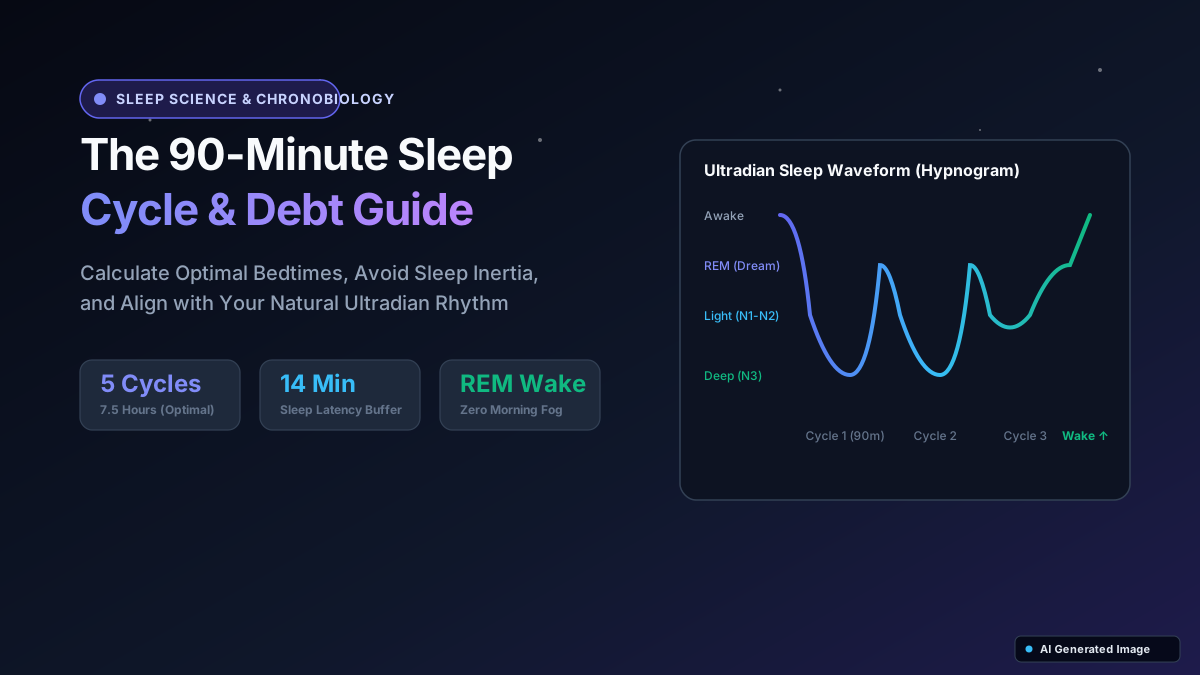
The answer lies in chronobiology: human sleep is not a uniform, continuous state of unconsciousness. Instead, your brain operates on biological ultradian rhythms—predictable 90-minute cycles that oscillate between light sleep, deep slow-wave repair, and rapid eye movement (REM) dreaming. Waking up at the wrong point in this cycle causes a severe neurochemical hangover known as sleep inertia. This comprehensive, research-backed guide explores the exact mathematical formulas, neuroscience, chronotypes, power nap protocols, and sleep debt recovery strategies that allow you to wake up energized every single morning.
Quick answer:A complete human sleep cycle lasts approximately 90 minutes, cycling through Stage 1 NREM, Stage 2 NREM, Stage 3 Slow-Wave Delta sleep, and REM dreaming sleep. To wake up feeling energized and clear-headed, you must wake up at the conclusion of a 90-minute cycle rather than in the middle of Stage 3 deep sleep. For most adults, 5 complete cycles (7.5 hours) or 6 complete cycles (9.0 hours)—plus 15 minutes of sleep onset latency—provides optimal hormonal recovery, immune function, and cognitive performance.
Why 'Sleep Calculator' Is One of the World's Most Searched Wellness Tools
In recent years, global search volume for terms like 'sleep calculator', 'sleep cycle calculator', 'sleep calc', and 'bedtime calculator' has skyrocketed, exceeding 2.5 million monthly searches globally. But what is driving this immense interest in digital sleep math?
Modern high-performers, shift workers, students, and busy parents face intense scheduling constraints. In major economies like the US, UK, Canada, and Australia, the Centers for Disease Control and Prevention (CDC) and NHS report that over 35% of adults suffer from chronic short sleep duration (less than 7 hours per night). However, the primary issue is not merely duration—it is **sleep timing mismatch**.
When people search for sleep calculations on Google, they are looking to solve four core daily challenges:
- 1. Exact Bedtime Timing: 'I have to wake up at 6:30 AM for work—what exact time must my head hit the pillow?'
- 2. Real-Time Sleep Planning: 'It is 11:42 PM right now—what time should I set my alarm for to avoid morning grogginess?'
- 3. Power Nap Calibration: 'How long can I nap right now without waking up feeling worse than before?'
- 4. Sleep Debt Reconciliation: 'I only got 5 hours of sleep on Tuesday and Wednesday—how do I safely catch up without ruining Sunday night?'
The Architecture of Human Sleep: The 90-Minute Ultradian Wave Explained
When you close your eyes at night, your brain does not simply shut down like a computer. Instead, it embarks on a sophisticated neurochemical journey. A standard healthy adult sleep cycle lasts approximately **90 to 110 minutes**, repeating 4 to 6 times per night.
Each 90-minute cycle is composed of four distinct stages, divided between Non-Rapid Eye Movement (NREM) sleep and Rapid Eye Movement (REM) sleep:
The Changing Composition of Nightly Cycles
Not all 90-minute cycles are identical throughout the night. During the first half of the night (first 3–4 hours), your cycles are heavily dominated by Stage 3 Deep Slow-Wave sleep to prioritize physical recovery. During the second half of the night (the final 3–4 hours), Stage 3 virtually disappears and REM dreaming sleep expands dramatically. This is why cutting your sleep short from 7.5 to 5 hours deprives you of over 60% of your critical REM cognitive sleep!
- Stage 1 NREM (Light Sleep / Transition — 5% of cycle): The bridge between wakefulness and sleep. Your breathing and heart rate slow down, muscles relax with occasional twitches (hypnic jerks), and brainwaves transition from active Beta/Alpha waves to slower Theta waves (4–7 Hz). You can be easily awakened during this 5–10 minute phase.
- Stage 2 NREM (Light Sleep & Spindles — 45–50% of cycle): Core body temperature drops and heart rate slows further. The brain generates rapid bursts of rhythmic brainwave activity called 'sleep spindles' and K-complexes. These neural spikes protect the brain from external auditory noise and facilitate the transfer of short-term memories from the hippocampus to the neocortex for long-term storage.
- Stage 3 NREM (Deep Slow-Wave Delta Sleep — 20–25% of cycle): The deepest, most restorative stage of physical sleep, characterized by high-amplitude, low-frequency Delta waves (0.5–4 Hz). During Stage 3, blood pressure drops, the pituitary gland releases up to 70% of the body's daily Human Growth Hormone (HGH), muscle tissues repair, and the brain's glymphatic system opens to flush out metabolic waste products (including beta-amyloid proteins associated with neurodegeneration).
- Stage 4 REM (Rapid Eye Movement Dream Sleep — 20–25% of cycle): Brainwave activity spikes to levels nearly identical to waking consciousness, eyes dart rapidly behind closed eyelids, and major voluntary muscles become temporarily paralyzed (muscle atonia) to prevent you from acting out dreams. REM sleep is critical for emotional regulation, creative synthesis, procedural motor memory, and mood stability.
| Sleep Stage | Dominant Brainwave | % of Night | Primary Biological Function | Effect If Woken During Stage |
|---|---|---|---|---|
| Stage 1 NREM | Theta (4–7 Hz) | 4% – 5% | Sensory dampening & drowsiness | Instant alertness; feels like you weren't asleep |
| Stage 2 NREM | Theta + Sleep Spindles | 45% – 50% | Memory consolidation & motor learning | Minimal grogginess; easy awakening |
| Stage 3 NREM (Slow-Wave) | Delta (0.5–4 Hz) | 20% – 25% | Tissue repair, immune boost, HGH release, glymphatic detox | Severe sleep inertia, disorientation, headache, heavy limbs |
| REM Sleep | Mixed Desynchronized Beta/Theta | 20% – 25% | Emotional processing, creative problem solving, dream synthesis | Vivid dream recall, mild grogginess, rapid mental clarity |
The Mathematical Formula: How the Sleep Calculator Determines Your Ideal Times
The mathematics powering our Sleep Calculator is derived from clinical chronobiology research. When you enter your desired wake-up time or bedtime, the tool applies two foundational parameters: **Sleep Onset Latency** and **90-Minute Ultradian Cycle Increments**.
According to sleep medicine research from Stanford and Harvard, healthy adults take an average of **14 to 15 minutes** to transition from turning off the lights to entering Stage 1 sleep (termed Sleep Onset Latency). Waking up at the crest between cycles—when the brain naturally surfaces into light Stage 1 or Stage 2 sleep—allows you to wake up feeling fresh and alert.
The Fundamental Sleep Cycle Equations
Bedtime = Desired Wake Time - (N × 90 minutes) - Sleep Latency (default: 15 min) Wake-Up Time = Bedtime + Sleep Latency (default: 15 min) + (N × 90 minutes) Where N is the number of complete sleep cycles (Optimal N = 5 or 6 cycles).
| Cycle Count | Total Sleep Duration | Calculated Bedtime | Optimal Quality Rating | Recommendation Context |
|---|---|---|---|---|
| 6 Cycles | 9 hrs 00 mins | 10:15 PM | 98% (Optimal) | Recommended for intense training, active recovery, or high cognitive workloads. |
| 5 Cycles | 7 hrs 30 mins | 11:45 PM | 92% (Suggested Gold Standard) | The optimal sweet spot for 85% of working adults. Complete energy with zero grogginess. |
| 4 Cycles | 6 hrs 00 mins | 1:15 AM | 75% (Sufficient) | Acceptable for occasional busy nights; maintains baseline alertness. |
| 3 Cycles | 4 hrs 30 mins | 2:45 AM | 55% (Minimum Sleep) | Emergency short sleep window. You avoid deep-sleep waking, but may feel tired by afternoon. |
| 2 Cycles | 3 hrs 00 mins | 4:15 AM | 38% (Short Rest) | Temporary survival sleep. Accumulates significant sleep debt. |
| 1 Cycle | 1 hr 30 mins | 5:45 AM | 25% (Emergency Reset) | Single full-cycle nap. Useful for shift workers or emergency red-eye travel. |
The Science of Sleep Inertia: Why Waking Up at the Wrong Time Ruins Your Entire Morning
Have you ever slept for 8 or 9 hours on a weekend, only to wake up feeling sluggish, irritable, and with a dull headache that takes two hours to shake off? That physiological phenomenon is known as **sleep inertia**.
Sleep inertia is a temporary state of impaired cognitive and sensory-motor performance that occurs immediately after waking. While mild sleep inertia lasts only 1 to 5 minutes, severe sleep inertia can persist for **30 to 90 minutes**, significantly impairing decision-making, spatial memory, reaction time, and emotional regulation.
The biological trigger for severe sleep inertia is being jarred awake during **Stage 3 Deep Slow-Wave Sleep**. In Stage 3, high levels of extracellular adenosine remain bound to cerebral receptors, blood flow to the prefrontal cortex is at its lowest 24-hour baseline, and brainwave activity is dominated by synchronized 1 Hz Delta waves. If a loud alarm abruptly rings while you are in this state, your brain cannot instantly shift to desynchronized 15–30 Hz Beta waves.
By contrast, when your alarm sounds at the end of a 90-minute cycle—when your body has naturally returned to Stage 1 or Stage 2 light sleep—cortisol levels have begun their natural morning rise (the Cortisol Awakening Response, or CAR), core body temperature is increasing, and your brain transitions seamlessly into full waking consciousness within seconds.
The 4 Sleep Chronotypes: Aligning Your Sleep Calculator Schedule with Your Biology
While 90-minute sleep cycles apply to all humans, the exact time your biological clock prefers to sleep is genetically predetermined. Pioneered by clinical psychologist Dr. Michael Breus and supported by circadian genetic studies (specifically the PER3 and CLOCK genes), humans fall into four distinct **sleep chronotypes**:
Attempting to force a late chronotype into an early schedule without proper light manipulation creates 'social jetlag'—a permanent mismatch between your internal biological clock and external societal demands.
How to Use the Sleep Calculator with Your Chronotype
If you are a Wolf (night owl) who must wake up at 7:00 AM for work, do not force yourself into bed at 9:30 PM (you will simply lie awake with sleep anxiety). Instead, select a 5-cycle target (11:15 PM bedtime) and use bright 10,000-lux light exposure immediately upon waking at 7:00 AM to advance your circadian phase.
| Chronotype | % of Population | Natural Sleep Window | Peak Mental Focus Hours | Ideal Sleep Schedule Profile |
|---|---|---|---|---|
| 🦁 Lion | ~15% | 9:30 PM – 5:30 AM | 8:00 AM – 12:00 PM | Early risers, high morning energy, proactive leaders. Fatigue sets in early around 8:30 PM. |
| 🐻 Bear | ~55% | 11:00 PM – 7:00 AM | 10:00 AM – 2:00 PM | Follows the solar cycle. Highly productive midday, requires consistent 7.5 to 8 hours sleep. |
| 🐺 Wolf | ~15% – 20% | 12:30 AM – 8:30 AM | 5:00 PM – 11:00 PM | Night owls, creative thinkers, slow to wake up in mornings, peak productivity in evening hours. |
| 🐬 Dolphin | ~10% | 11:30 PM – 6:30 AM | 3:00 PM – 9:00 PM | Light sleepers, anxious or fragmented sleep, highly intelligent, prone to insomnia. |
Sleep Debt: The Hidden Metabolic & Cognitive Cost of Chronic Deficits
Sleep debt is the cumulative difference between the amount of sleep your body biologically requires and the amount of sleep you actually obtain. If your body requires 7.5 hours per night (5 cycles) and you only sleep 6.0 hours (4 cycles) from Monday through Friday, you accumulate **7.5 hours of net sleep debt** by the weekend.
Groundbreaking research from the University of Pennsylvania's Perelman School of Medicine demonstrated that restricting sleep to **6 hours per night for 14 consecutive days** produced cognitive, working memory, and motor reaction impairments equivalent to staying awake for **24 to 48 continuous hours** (or having a Blood Alcohol Concentration of 0.08%, legal intoxication). Crucially, the participants reported feeling 'only slightly tired', unaware of their severe objective cognitive decline.
Worse, chronic sleep debt triggers systemic physiological damage:
The Weekend Binge Sleep Fallacy
You cannot undo 10 hours of weekday sleep debt by sleeping for 13 hours on Sunday. Marathon weekend oversleeping delays your circadian melatonin onset on Sunday evening, making it impossible to fall asleep before 1:30 AM and triggering miserable 'Monday Morning Blue' fatigue. Instead, pay off sleep debt by adding 45 to 60 minutes of extra sleep across 5 to 7 consecutive nights.
- Metabolic & Appetite Dysregulation: Restricting sleep to less than 6 hours suppresses Leptin (the satiety hormone) by 18% and elevates Ghrelin (the hunger hormone) by 28%, triggering intense cravings for refined carbohydrates and sugar.
- Insulin Resistance: Just 3 nights of 4-hour sleep reduces insulin sensitivity in healthy young adults by up to 30%, shifting their metabolic profile toward prediabetes.
- Immune Suppression: Studies published in the journal *Sleep* found that individuals sleeping less than 6 hours per night are **4.2 times more likely** to catch the common cold when exposed to rhinovirus compared to those sleeping 7 or more hours.
- Cardiovascular Strain: Chronic sleep restriction elevates nighttime systolic blood pressure, increases systemic inflammation markers (C-Reactive Protein and IL-6), and doubles coronary calcification rates.
The Science of Power Napping: 20-Min vs. 26-Min NASA vs. 90-Min REM Naps
Napping is one of the most potent biological hacks for restoring cognitive function, clearing cerebral adenosine, and boosting motor accuracy. However, napping for the wrong duration can plunge you into deep sleep and ruin your entire afternoon.
Our Sleep Calculator includes dedicated power nap modes based on the following scientific protocols:
| Nap Protocol | Duration | Sleep Stages Reached | Primary Performance Benefit | Ideal Time of Day |
|---|---|---|---|---|
| ⚡ 20-Min Power Nap | 20 Minutes | Stages 1 & 2 NREM | Rapid restoration of alertness, focus, and motor speed with zero grogginess. | 1:00 PM – 3:00 PM |
| 🚀 26-Min NASA Pilot Nap | 26 Minutes | Stages 1 & 2 NREM | Tested on commercial airline pilots; increased overall performance by 34% and alertness by 54%. | 1:30 PM – 3:30 PM |
| ☕ Coffee Nap (Nappuccino) | 20 Minutes | Stage 1 NREM + Caffeine | Drink espresso immediately before napping. Adenosine clears during sleep while caffeine kicks in at 20 min. | 1:00 PM – 2:30 PM |
| 🧠 90-Min Full Cycle Nap | 90 Minutes | Full NREM + REM Cycle | Boosts creative problem-solving, procedural memory, emotional balance, and physical muscle repair. | 12:30 PM – 2:00 PM |
Clinical Sleep Hygiene Protocols: Maximizing Your 90-Minute Sleep Cycles
Using a Sleep Calculator ensures you go to bed and wake up at mathematically optimal times. However, to guarantee you fall asleep quickly and spend ample time in Stage 3 deep and REM sleep, implement these four evidence-based sleep hygiene protocols:
- 1. Master the Light-Dark Cycle (Photon Timing): Within 30 minutes of waking, expose your eyes to 10–15 minutes of direct natural sunlight (or a 10,000-lux daylight therapy lamp). This triggers a healthy morning cortisol surge and sets a 14-hour biological timer for evening melatonin release. In the evening, dim overhead lighting after 8:30 PM and avoid blue-light screens 60 minutes before bed.
- 2. Cool Your Sleeping Sanctuary to 65°F (18.3°C): For your brain to initiate sleep, your core body temperature must drop by approximately 2°F (1°C). Sleeping in a cool room (65°F to 68°F / 18°C to 20°C) promotes uninterrupted Stage 3 slow-wave deep sleep.
- 3. Respect the Caffeine Half-Life: Caffeine has an average metabolic half-life of 5 to 7 hours and a quarter-life of 10 to 12 hours. If you consume a 200 mg coffee at 4:00 PM, 50 mg of caffeine remains active in your brain at 2:00 AM, significantly degrading Stage 3 deep sleep quality even if you fall asleep easily. Stop all caffeine consumption 10 hours before your calculated bedtime.
- 4. Beware the Alcohol Sedation Trap: While alcohol acts as a central nervous system depressant that helps you fall asleep faster, it destroys sleep architecture. As the liver metabolizes alcohol into acetaldehyde during the night, it severely fragments sleep, suppresses REM dreaming by up to 80%, and triggers frequent awakenings around 3:00 AM.
Official Age-Specific Sleep Duration Guidelines (AASM & National Sleep Foundation)
Sleep requirements change dramatically across the human lifespan as brain development, hormonal output, and metabolic needs evolve. The table below outlines the official consensus guidelines established by the American Academy of Sleep Medicine (AASM) and the National Sleep Foundation:
| Age Category | Age Range | Recommended Nightly Sleep | Ideal Cycle Equivalent | Primary Developmental Focus |
|---|---|---|---|---|
| Newborns | 0–3 Months | 14 to 17 Hours | Polyphasic (8–10 mini-cycles) | Rapid brain growth and nervous system development. |
| Infants | 4–11 Months | 12 to 15 Hours | Polyphasic (including 2–3 naps) | Motor skill consolidation and circadian rhythm emergence. |
| Toddlers | 1–2 Years | 11 to 14 Hours | 6–7 Cycles + Afternoon Nap | Language acquisition and physical growth hormone output. |
| Preschoolers | 3–5 Years | 10 to 13 Hours | 6–7 Cycles | Social-emotional regulation and cognitive expansion. |
| School-Age Children | 6–13 Years | 9 to 11 Hours | 6–7.5 Cycles | Executive functioning, academic learning, and immune resilience. |
| Teenagers | 14–17 Years | 8 to 10 Hours | 5.5–6.5 Cycles | Prefrontal cortex remodeling and pubertal hormonal balance. |
| Adults | 18–64 Years | 7 to 9 Hours | 5 to 6 Cycles (Gold Standard) | Cognitive maintenance, memory retention, and physical repair. |
| Older Adults | 65+ Years | 7 to 8 Hours | 4.5 to 5.5 Cycles | Cellular defense, memory protection, and metabolic health. |
Frequently Asked Questions
Click any question below to expand quick answers, formulas, and expert tips.
What is a 90-minute sleep cycle and how does it work?
A 90-minute sleep cycle is the natural ultradian rhythm through which the brain moves during sleep. Each cycle consists of Stage 1 light sleep, Stage 2 light sleep (sleep spindles), Stage 3 slow-wave deep sleep, and REM dreaming sleep. Waking up at the boundary between cycles—during light sleep—prevents sleep inertia and allows you to wake up feeling refreshed.
Why do I feel more tired when I sleep 8 hours instead of 7.5 hours?
Sleeping 8 hours (480 minutes) with a 15-minute sleep latency means you have been asleep for 465 minutes, which equals 5.16 cycles. This lands you right in the middle of Stage 3 deep slow-wave sleep. Waking from deep sleep shocks your nervous system and causes severe sleep inertia (brain fog). Sleeping 7.5 hours (450 minutes) completes exactly 5 cycles, allowing you to wake from light sleep with natural alertness.
How long does it take the average person to fall asleep?
Clinical sleep studies establish that the average healthy adult takes between 10 and 20 minutes to fall asleep (known as sleep onset latency), with 14 to 15 minutes being the standard clinical benchmark. Falling asleep in under 5 minutes often indicates severe sleep deprivation, while taking longer than 30 minutes may indicate insomnia or circadian phase delay.
What is the best time to go to bed if I have to wake up at 6:00 AM?
For a 6:00 AM wake-up time, your ideal bedtimes are 8:45 PM (6 cycles, 9.0 hours of sleep), 10:15 PM (5 cycles, 7.5 hours of sleep - recommended for most adults), or 11:45 PM (4 cycles, 6.0 hours of sleep). All times include a 15-minute window to fall asleep.
What is the difference between deep sleep and REM sleep?
Deep sleep (Stage 3 NREM) is physical recovery: your body repairs muscles, builds bone, releases human growth hormone, and clears metabolic waste from the brain via the glymphatic system. REM sleep is cognitive and emotional recovery: your brain processes memories, regulates mood, dreams, and synthesizes creative neural connections.
How does a 20-minute power nap work?
A 20-minute power nap allows your brain to enter Stage 1 and Stage 2 light sleep, which clears accumulated adenosine (the fatigue chemical) without allowing you to enter Stage 3 deep slow-wave sleep. Because you avoid deep sleep, you wake up instantly alert with zero morning grogginess or post-nap sluggishness.
What is a 'Coffee Nap' (Nappuccino)?
A Coffee Nap involves drinking a cup of coffee or espresso immediately before lying down for a 20-minute power nap. Adenosine naturally clears from your brain receptors during the 20 minutes of light sleep. Right as you wake up, the caffeine reaches your bloodstream and binds to those newly cleared receptors, creating an amplified boost in focus and alertness.
Can I make up for lost sleep on the weekend?
Not entirely. While extra sleep helps reduce acute fatigue, weekend marathon sleeping disrupts your circadian pacemaker (causing 'social jetlag'). It delays your Sunday night sleep onset, creating severe Monday morning exhaustion. The healthiest way to recover from sleep debt is adding 30 to 60 minutes of sleep each night over 5 to 7 days.
What are the 4 sleep chronotypes?
The 4 chronotypes are Lion (early risers, ~15%), Bear (standard solar cycle risers, ~55%), Wolf (night owls, ~15-20%), and Dolphin (light/fragmented sleepers, ~10%). Aligning your calculated sleep schedule with your natural genetic chronotype optimizes melatonin release and daytime energy.
Is 6 hours of sleep enough for an adult?
For over 97% of the human population, 6 hours of sleep is biologically insufficient. Less than 3% of adults possess the rare DEC2 or ADRB1 genetic mutations that allow them to thrive on short sleep without cognitive or cardiovascular decline. For everyone else, 5 to 6 complete cycles (7.5 to 9 hours) is necessary for long-term health.
The Bottom Line
Optimizing your sleep is the highest-leverage intervention you can make for your cognitive performance, metabolic health, emotional balance, and longevity. By timing your bedtimes and wake alarms to complete 90-minute ultradian cycles, you eliminate sleep inertia and wake up feeling energized. Use our free, 100% private Sleep Calculator every day to align your schedule with your biology.
This article is for informational and educational purposes. Always verify complex calculations with a qualified professional or official documentation.