Every financial transaction in the global economy exists in one of two states: pre-tax (net) or post-tax (gross). Whether you are a small business owner issuing commercial invoices, an e-commerce merchant navigating cross-border shipments, a consumer auditing a supermarket receipt, or an employee evaluating an overseas job offer, knowing how to navigate between these two states is a fundamental practical skill.
Yet, despite how common sales taxes, Value Added Taxes (VAT), and payroll deductions are, mathematical errors remain widespread. Businesses regularly lose revenue by using the wrong formula to extract tax from gross receipts, while job seekers frequently confuse gross headline compensation with actual in-hand spendable cash. This comprehensive guide breaks down the exact algebraic equations, structural tax models across Tier-1 economies, and payroll deductions needed to calculate your numbers with complete precision.
Quick answer:To add sales tax or VAT (pre-tax to post-tax), multiply the net price by (1 + Tax Rate). To extract sales tax or VAT from a tax-inclusive receipt (post-tax to pre-tax), divide the gross total by (1 + Tax Rate); never multiply by (1 - Tax Rate), which creates a mathematical under-calculation error. For salary take-home pay, net in-hand compensation equals Gross Salary minus statutory income taxes, retirement contributions, and mandatory social insurance (e.g., FICA in the US, National Insurance in the UK, Superannuation in Australia).
1. The Fundamental Mathematics: Forward Addition vs. Reverse Tax Extraction
Understanding tax math begins with recognizing that adding tax to a price and extracting tax from a total are mathematically asymmetric operations. When calculating forward from a pre-tax net cost, the tax rate percentage is applied to the net base. When reversing from a gross receipt total back to the net base, you cannot simply subtract that same percentage from the gross figure.
Consider a standard purchase where an item costs $100.00 net and is subject to a 20% sales tax or VAT rate. The forward calculation is straightforward: $100.00 × 0.20 = $20.00 tax, resulting in a grand total of $120.00 gross. The general forward formula is expressed as: Gross = Net × (1 + r), where r represents the decimal tax rate (0.20).
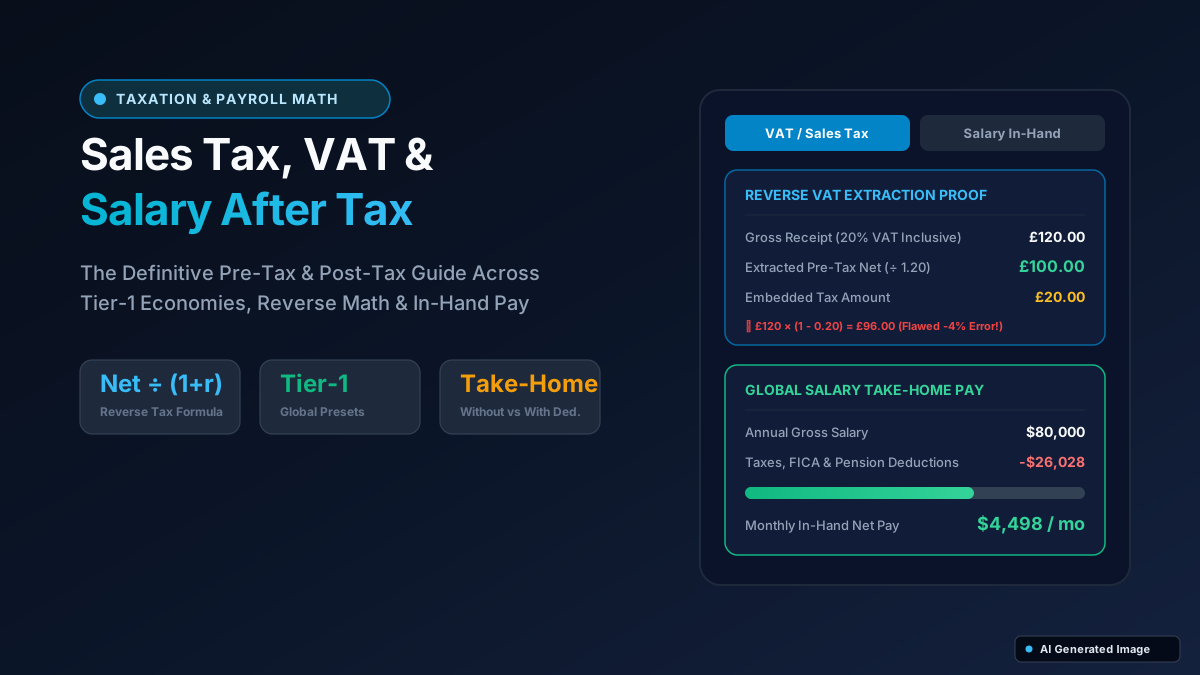
Now consider the reverse problem: you receive an expense receipt showing a tax-inclusive total of $120.00, and you must extract the embedded tax for your bookkeeping or VAT refund reclaim. A widespread amateur mistake is to multiply $120.00 by 20% ($24.00) and subtract it, arriving at $96.00. That calculation is completely wrong. If the pre-tax price were $96.00, adding 20% tax ($19.20) would produce only $115.20, leaving a $4.80 discrepancy.
The algebraically correct reverse tax equation isolates Net by dividing the gross figure: Net = Gross ÷ (1 + r). For our $120.00 receipt with 20% VAT, the pre-tax net cost is $120.00 ÷ 1.20 = $100.00. The embedded tax is then found by subtracting Net from Gross: $120.00 - $100.00 = $20.00. This single formula prevents thousands of dollars in accounting discrepancies each year.
The 20% Extraction Fallacy
Never calculate embedded VAT by multiplying Gross × (1 - Rate). A 20% tax on net is mathematically equivalent to a 16.67% share of the gross total (1 ÷ 1.20 = 0.8333). Always use Net = Gross ÷ (1 + r).
2. Sales Tax vs. Value Added Tax (VAT) vs. Goods & Services Tax (GST)
While consumers often use the terms interchangeably, Sales Tax, VAT, and GST represent distinct taxation architectures with fundamentally different administrative and economic rules.
Retail Sales Tax (utilized primarily in the United States) is a single-stage consumption tax levied solely at the final point of purchase by the end consumer. Raw materials, manufacturing components, and wholesale inventory are typically exempt from sales tax through resale certificates. In the United States, there is no federal sales tax; instead, taxation is decentralized across 45 states, plus the District of Columbia and thousands of local municipal jurisdictions, resulting in combined rates ranging from 0% in states like Oregon and Delaware to over 10% in parts of Louisiana and Washington state.
Value Added Tax (standard across the United Kingdom, European Union, and most OECD economies) is a multi-stage tax collected incrementally at every step of the supply chain. Each business pays VAT on its purchases (input tax) and charges VAT on its sales (output tax), remitting only the difference to the government. This mechanism eliminates the cascading 'tax-on-tax' effect seen in legacy turnover systems while creating an auditable paper trail that deters tax evasion.
Goods and Services Tax (GST) is a modern evolution of the VAT concept, adopted by countries like Canada, Australia, New Zealand, Singapore, and India. While structurally similar to VAT, GST frameworks typically feature broader tax bases, fewer exemptions, and unified administrative portals designed for high digital compliance.
| Tax System | Primary Jurisdictions | Collection Mechanism | Input Tax Credits? | Price Display Standard |
|---|---|---|---|---|
| Retail Sales Tax | United States | Single-stage at final retail sale | No (Resale certificates used) | Exclusive (Added at checkout) |
| Value Added Tax (VAT) | UK, EU, Switzerland, Norway | Multi-stage on value added | Yes (Input VAT reclaimed) | Inclusive (Mandatory consumer retail) |
| Goods & Services Tax (GST) | Canada, Australia, NZ, Singapore | Multi-stage comprehensive base | Yes (Business credits) | Inclusive (AU/NZ), Exclusive (CA) |
| Consumption Tax | Japan (Shōhizei) | Multi-stage unified credit | Yes (Qualified invoices) | Inclusive (Total price display) |
3. Tier-1 Global Tax Matrix: Statutory Rates and Rules Across 18 Major Jurisdictions
When operating internationally or purchasing goods across borders, knowing the statutory benchmark rates for key economies is essential. Most countries maintain a standard rate along with reduced tiers for essential goods such as basic foodstuffs, pharmaceutical supplies, books, and passenger transit.
The table below details the official standard and reduced tax rates, local currencies, and typical payroll income tax brackets across 18 major global economies:
| Country | Currency | Tax System Name | Standard Rate | Reduced Rate | Typical Income Tax Bracket |
|---|---|---|---|---|---|
| United States | USD ($) | State & Local Sales Tax | 6.50% (Avg) | 0.0% (Exempt items) | 22.0% Federal + State |
| United Kingdom | GBP (£) | Value Added Tax (VAT) | 20.0% | 5.0% / 0.0% | 20.0% Basic / 40.0% Higher |
| Canada | CAD ($) | GST / HST / PST | 13.0% (ON) | 5.0% (GST only) | 20.5% - 26.0% Combined |
| Australia | AUD ($) | Goods & Services Tax (GST) | 10.0% | 0.0% (Fresh food) | 30.0% Marginal + 2% Medicare |
| Germany | EUR (€) | Mehrwertsteuer (MwSt) | 19.0% | 7.0% (Food/Books) | 30.0% - 42.0% + Solidarity |
| France | EUR (€) | Taxe sur la Valeur Ajoutée (TVA) | 20.0% | 5.5% / 10.0% | 25.0% - 30.0% Marginal |
| Japan | JPY (¥) | Consumption Tax (Shōhizei) | 10.0% | 8.0% (Groceries) | 20.0% National + 10% Local |
| Switzerland | CHF (CHF) | Mehrwertsteuer (MWST) | 8.10% | 2.60% (Food/Meds) | 15.0% - 20.0% Fed/Canton |
| Netherlands | EUR (€) | BTW (VAT) | 21.0% | 9.0% (Food/Water) | 36.97% Box 1 Base Rate |
| Spain | EUR (€) | Impuesto sobre el Valor Añadido (IVA) | 21.0% | 10.0% / 4.0% | 24.0% - 30.0% IRPF |
| Italy | EUR (€) | Imposta sul Valore Aggiunto (IVA) | 22.0% | 10.0% / 4.0% | 35.0% Ordinary Bracket |
| Sweden | SEK (kr) | Mervärdesskatt (Moms) | 25.0% | 12.0% / 6.0% | 32.0% Municipal Tax Avg |
| Norway | NOK (kr) | Merverdiavgift (MVA) | 25.0% | 15.0% / 12.0% | 34.0% Combined Income Tax |
| Denmark | DKK (kr) | Merværdiafgift (Moms) | 25.0% | 0.0% (No reduced tier) | 37.0% - 52.0% Progressive |
| New Zealand | NZD ($) | Goods & Services Tax (GST) | 15.0% | 0.0% (Few exemptions) | 25.0% - 33.0% PAYE |
| Singapore | SGD ($) | Goods & Services Tax (GST) | 9.0% | 0.0% (Financial/Exports) | 15.0% Resident Bracket |
| Ireland | EUR (€) | Value Added Tax (VAT) | 23.0% | 13.5% / 9.0% | 20.0% Standard / 40.0% Higher |
| India | INR (₹) | Goods & Services Tax (GST) | 18.0% (Std) | 5.0% / 12.0% / 28.0% | 20.0% - 30.0% Slabs |
4. Cross-Border Invoicing, E-Commerce & Reverse Charge Mechanisms
In the modern interconnected economy, business transactions frequently cross international borders, creating complex tax liability questions for independent contractors, digital agencies, and e-commerce merchants.
Under European Union VAT rules, Business-to-Business (B2B) transactions across member state borders utilize the Reverse Charge Mechanism. Under this rule, the supplier issues an invoice without charging VAT (0% VAT rate), and the buyer accounts for both the input and output VAT on their domestic VAT return. This mechanism eliminates the need for foreign suppliers to register for VAT in every customer's home country.
In contrast, Business-to-Consumer (B2C) digital sales are generally taxed at the destination country rate under frameworks such as the EU One Stop Shop (OSS) or the UK HMRC overseas seller regulations. A US software company selling a digital subscription to a consumer in Germany must collect and remit 19% German MwSt, whereas the same sale to a French consumer requires 20% French TVA.
For cross-border freelancers, maintaining separate line items on your invoices for Net Subtotal, Applicable Tax Rate (or Reverse Charge citation with customer VAT ID), and Grand Total is required by tax authorities to ensure full deductibility for business clients.
B2B Invoice Compliance Requirement
When issuing a cross-border invoice under reverse charge rules, always state: 'Reverse Charge: VAT to be accounted for by the recipient under Article 196 of the EU VAT Directive 2006/112/EC' alongside both parties' valid VAT identification numbers.
5. Salary After Tax & In-Hand Pay: Bridging Gross Headline Pay to Real Take-Home Cash
Just as retail prices have pre-tax and post-tax values, employee compensation has two distinct figures: Gross Salary and Net In-Hand Pay. While employment contracts and job offers quote gross annual compensation, the amount deposited into your bank account on payday is significantly lower.
The gap between gross and net compensation is determined by statutory income tax brackets, mandatory social insurance contributions, and employee-selected pre-tax benefit elections.
A frequent source of anxiety among employees is a misunderstanding of progressive tax brackets. When tax rates increase across income tiers (for example, 10% on the first $11,600, 12% up to $47,150, and 22% up to $100,525 in the US), only the dollars earned within each specific bracket are taxed at that higher rate. Moving into a higher tax bracket never reduces your net take-home pay; it simply applies the higher rate to the incremental earnings above the threshold.
To accurately project your in-hand cash flow, you must translate annual figures into paycheck frequencies. An annual gross salary of $75,000 corresponds to $6,250.00 monthly, $2,884.62 bi-weekly (paid every two weeks, 26 pay periods per year), and $1,442.31 weekly.
6. Without Deductions vs. With Deductions: How Itemized Payroll Adjustments Change Your Paycheck
When calculating salary after tax, calculators typically offer two distinct modes: 'Without Deductions' and 'With Deductions'. Understanding the distinction between these modes is critical for accurate financial planning.
In 'Without Deductions' mode, a flat effective tax percentage is applied directly to total gross earnings. While this provides a quick preliminary benchmark, it does not reflect the nuanced reality of statutory payroll systems, where governments provide standard deductions and allow pre-tax retirement savings.
In 'With Deductions' mode, the calculation engine mirrors actual payroll software by processing pre-tax adjustments in their legal sequence. For example, in the United States, an employee earning an $80,000 gross salary who contributes 5% ($4,000) to an employer-sponsored 401(k) plan and takes the $14,600 standard deduction has a taxable income of only $61,400 ($80,000 - $4,000 - $14,600). Their federal income tax is calculated on $61,400 rather than $80,000, saving hundreds of dollars annually.
Meanwhile, mandatory payroll taxes—such as FICA in the United States (6.2% Social Security + 1.45% Medicare = 7.65%), National Insurance in the United Kingdom, or CPP/EI in Canada—are calculated on total gross wages before standard deductions. Factoring in employee-paid monthly health insurance premiums ($150 to $400/month) yields the true in-hand take-home paycheck.
| Payroll Line Item | Without Deductions (Flat 22%) | With Deductions (Itemized Standard) |
|---|---|---|
| Annual Gross Salary | $80,000.00 | $80,000.00 |
| Pre-Tax 401(k) Retirement (5%) | $0.00 (Not modeled) | -$4,000.00 (Reduces taxable base) |
| Standard Personal Deduction | $0.00 | -$14,600.00 (Tax exemption) |
| Taxable Income Base | $80,000.00 | $61,400.00 |
| Federal Income Tax (22%) | -$17,600.00 | -$13,508.00 |
| FICA Social Security & Medicare (7.65%) | -$6,120.00 | -$6,120.00 |
| Health Insurance ($200/mo) | $0.00 | -$2,400.00 |
| Total Annual Deductions | -$23,720.00 | -$26,028.00 |
| Annual Net In-Hand Take-Home | $56,280.00 | $53,972.00 |
| Monthly In-Hand Net Pay | $4,690.00 / month | $4,497.67 / month |
7. Practical Checklist: How to Audit Your Invoices, Paystubs, and Purchase Receipts
Whether you are reconciling business expenses, negotiating an employment offer, or checking retail receipts, following a structured audit protocol ensures total mathematical and legal accuracy:
1. Confirm Pre-Tax vs. Post-Tax Status: Determine whether the stated price or offer is tax-inclusive or tax-exclusive before performing any arithmetic.
2. Verify the Statutory Rate: Check whether standard, reduced, or zero tax rates apply to the specific category of goods or services being invoiced.
3. Apply Deterministic Math: Use Net = Gross ÷ (1 + r) for reverse tax extraction; never subtract the percentage directly from the gross total.
4. Review Pre-Tax Benefit Elections: When evaluating salary offers, calculate the tax shield provided by 401(k), workplace pensions, and health savings accounts.
5. Verify Local Jurisdictional Rules: In jurisdictions like the United States or Canada, remember to combine federal, state/provincial, and municipal tax rates for the exact delivery address.
- Check whether the headline price includes or excludes sales tax or VAT.
- Audit supplier invoices for correct tax identification numbers (VAT ID / EIN / ABN).
- Ensure pre-tax deductions are subtracted before calculating income tax liability.
- Separate mandatory payroll contributions (FICA / NI) from income tax withholdings.
- Convert annual compensation into bi-weekly or monthly figures for realistic budgeting.
Frequently Asked Questions
Click any question below to expand quick answers, formulas, and expert tips.
How do I calculate pre-tax price from a tax-inclusive total?
To extract the pre-tax price from a tax-inclusive receipt, divide the total gross amount by (1 + Tax Rate). For example, if a receipt totals $120.00 with a 20% tax rate, calculate $120.00 ÷ 1.20 = $100.00. The pre-tax net cost is $100.00 and the tax amount is $20.00.
Why can't I just subtract 20% from a tax-inclusive price of $120?
Subtracting 20% from $120 gives $96, which is incorrect because the original 20% tax was calculated on the smaller base ($100), not the larger total ($120). Adding 20% back to $96 yields only $115.20, creating an erroneous $4.80 shortage. The mathematically sound approach is always division: $120 ÷ 1.20 = $100.
What is the primary difference between Sales Tax and VAT?
Sales tax is a single-stage tax collected only at the final point of retail sale to the consumer (common in the US). Value Added Tax (VAT) is a multi-stage tax collected incrementally across every phase of production and distribution, with registered businesses claiming credits for input VAT paid.
How does salary take-home pay differ between simple and itemized modes?
Simple mode applies a single estimated flat effective tax rate to total gross earnings. Itemized mode accounts for legal tax thresholds, pre-tax retirement contributions (401k/pension), standard tax-free personal allowances, mandatory social insurance (FICA/National Insurance), and health insurance premiums.
Does moving into a higher income tax bracket reduce my net pay?
No. Under modern progressive tax systems, moving into a higher tax bracket only taxes the incremental dollars earned above that bracket threshold at the higher percentage. Your earnings below the threshold continue to be taxed at the lower progressive rates.
Can I edit the tax rates and country presets in the Homecalpro calculator?
Yes. Selecting any Tier-1 country (US, UK, Canada, Australia, Germany, France, Japan, etc.) auto-populates standard statutory rates and local currency symbols, but all percentage rates, deduction amounts, and base prices remain 100% editable.
What is the Reverse Charge Mechanism in international B2B invoicing?
The Reverse Charge Mechanism is an international tax rule where the obligation to account for VAT is transferred from the foreign supplier to the business customer. The supplier issues an invoice with 0% VAT, and the recipient declares both output and input VAT on their domestic tax return.
How do bi-weekly and semi-monthly paychecks differ?
Bi-weekly pay occurs every two weeks, resulting in 26 pay periods per year (with two months having three paychecks). Semi-monthly pay occurs twice per month (typically on the 1st and 15th), resulting in exactly 24 pay periods per year. A $75,000 salary yields $2,884.62 bi-weekly versus $3,125.00 semi-monthly.
The Bottom Line
Mastering pre-tax and post-tax arithmetic protects your business from costly invoicing errors and gives employees total transparency into their true take-home pay. Always remember the fundamental rule of reverse tax extraction: divide by (1 + r), never subtract the percentage directly. Use our verified, zero-latency Sales Tax & VAT Calculator to model transactions, compare Tier-1 country rates, and audit your paychecks with complete mathematical confidence.
This article is for informational and educational purposes. Always verify complex calculations with a qualified professional or official documentation.