There is a familiar, gut-wrenching moment that nearly every American homebuyer experiences today. You find a modest single-family home listed online for $425,000. The listing portal boldly displays an inviting green badge: 'Estimated payment: $2,250/month.' You run a quick mental budget check against your household income, attend the crowded Sunday open house, fall in love with the neighborhood, and submit an offer. But three weeks later, when your lender delivers the official Loan Estimate disclosure, you freeze: the true monthly payment is not $2,250—it is $3,285 per month.
That $1,035 monthly discrepancy—more than $12,400 every single year—is where financial stress, marital arguments, and buyer remorse take root. It represents the gap between bank marketing and the harsh realities of modern US housing: front-loaded amortization schedules, mandatory escrow accounts, skyrocketing hazard insurance premiums, aggressive county tax reassessments, and private mortgage insurance (PMI). In a housing market defined by benchmark 30-year fixed rates hovering between 6.5% and 7.5%, the margin for error is zero.
An accurate, independent mortgage calculator is not a luxury or a curiosity; it is the most vital defensive tool an American consumer can wield. This guide breaks down the raw mathematics of home lending, pulls back the curtain on lender underwriting formulas, exposes the hidden pain points that drain family bank accounts, and provides concrete, field-tested strategies to save tens of thousands of dollars over the life of your loan.
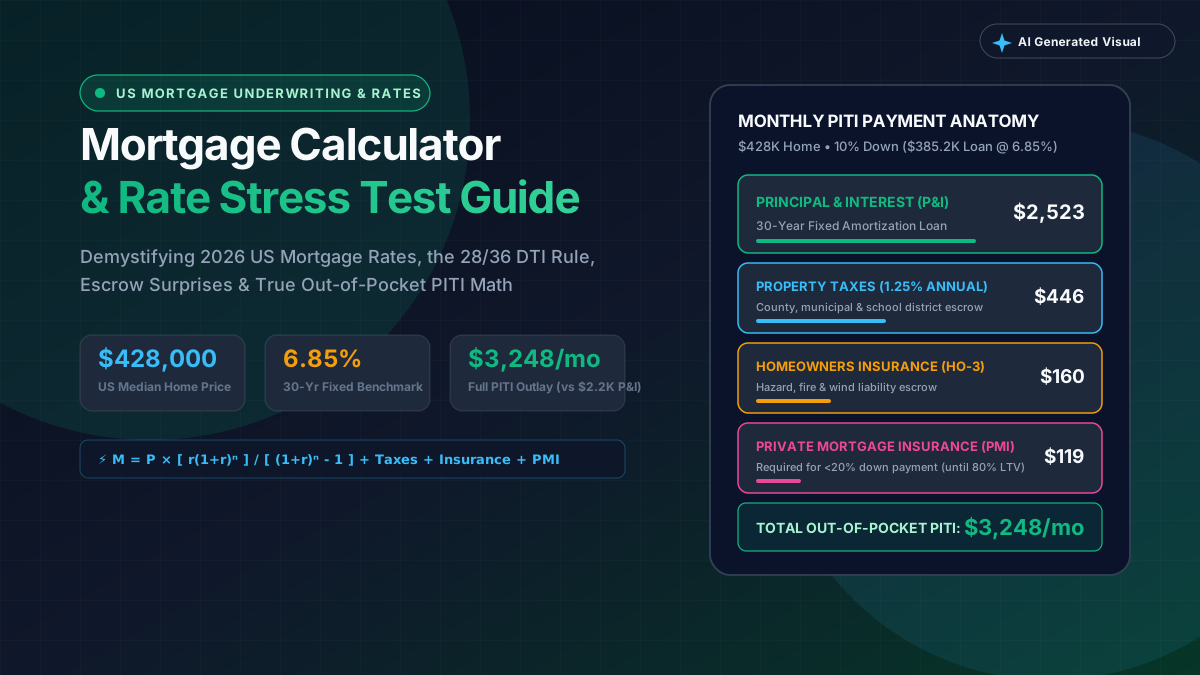
Quick answer:To calculate your true monthly mortgage payment in the United States, never rely on Principal & Interest (P&I) alone. The complete monthly housing obligation equals PITI: Monthly P&I [P × (r(1+r)ⁿ) / ((1+r)ⁿ - 1)] + Monthly Property Taxes (Annual County Assessment / 12) + Monthly Hazard Insurance (Annual Premium / 12) + Monthly Private Mortgage Insurance (PMI, if down payment < 20%) + Monthly HOA / CDD dues. On a median $428,000 US home with 10% down at a 6.85% 30-year fixed rate, raw P&I is $2,523/month, but true out-of-pocket PITI is $3,248/month—a $725/month difference that breaks unqualified budgets.
1. The Modern American Housing Dilemma: Rate Shock and the 'Locked-In' Reality
Why today's 6.5%–7.5% rate environment feels completely different from historical cycles
To understand why buying a home feels so daunting today, one must confront the profound psychological and mathematical shock of modern interest rates. For over a decade following the 2008 Great Financial Crisis, and culminating in the emergency stimulus of 2020–2021, American buyers enjoyed historic 30-year fixed rates between 2.75% and 3.75%. Millions of households secured loans where the cost of borrowing money was effectively lower than the rate of general inflation.
When the Federal Reserve initiated aggressive monetary tightening to tame post-pandemic inflation, mortgage rates surged to over 7.5% in record time. While seasoned economists frequently point out that the historical 50-year US average mortgage rate is approximately 7.7%, that comparison ignores a catastrophic structural difference: in the 1980s and 1990s, when rates were 8% to 12%, the median American home price was 3 to 4 times median household income. Today, the median home price in the United States exceeds 6.5 times median household income.
The mathematical consequence of this divergence is brutal. Consider a standard $400,000 loan balance on a 30-year fixed schedule across different interest rate benchmarks:
The $350,000 Rate Gap
Comparing a $400,000 loan at 3.0% versus 7.0%, the monthly Principal and Interest payment jumps by $975 every single month. Over 30 years, that single 4-percentage-point difference extracts an extra $350,927 in pure bank interest for the exact same physical property. This explains why millions of existing homeowners who hold sub-3.5% mortgages refuse to sell, creating an artificial inventory drought that keeps home prices near record highs despite high borrowing costs.
| Interest Rate | Monthly P&I Payment | Total Lifetime Interest Paid | Total Cost of $400K Loan | Minimum Annual Income Needed (28% Front DTI) |
|---|---|---|---|---|
| 3.00% (2021 Benchmark) | $1,686 / month | $207,109 | $607,109 | $72,250 / year |
| 4.50% (Transitional) | $2,027 / month | $329,627 | $729,627 | $86,870 / year |
| 5.50% (Moderate Climate) | $2,271 / month | $417,610 | $817,610 | $97,330 / year |
| 6.50% (Current Baseline) | $2,528 / month | $510,178 | $910,178 | $108,340 / year |
| 7.00% (Elevated Market) | $2,661 / month | $558,036 | $958,036 | $114,040 / year |
| 7.50% (Tight Credit Cycle) | $2,797 / month | $606,868 | $1,006,868 | $119,870 / year |
| 8.00% (Peak Stress Test) | $2,935 / month | $656,616 | $1,056,616 | $125,780 / year |
2. The PITI Trap: Why 'Principal & Interest' Is Only 65% of Your Actual Monthly Bill
Deconstructing the four letters that govern American homeownership
In addition to standard PITI, buyers frequently face two additional ongoing expenses that are legally bundled into their monthly obligations: Private Mortgage Insurance (PMI) for conventional loans with less than 20% down payment, and Homeowners Association (HOA) or Condominium dues for properties located in master-planned communities.
Let us examine how PITI fundamentally alters the true monthly cost of purchasing a median-priced American home:
The Standard 30-Year Fixed Mortgage Amortization Formula
M = P × [ r(1+r)ⁿ ] / [ (1+r)ⁿ - 1 ] Where: M = Monthly P&I Payment, P = Principal Loan Amount, r = Monthly Interest Rate (Annual Rate / 12), n = Total Number of Payments (30 Years × 12 = 360 Months).
- P — Principal: The portion of your monthly payment that directly pays down the outstanding loan balance, building true home equity.
- I — Interest: The fee charged by the lender for the privilege of borrowing capital, calculated monthly against your remaining loan balance.
- T — Property Taxes: County, municipal, and local school district taxes assessed against your home's taxable value, collected monthly by your servicer into an escrow account.
- I — Hazard / Homeowners Insurance: Mandatory insurance protection covering fire, windstorm, lightning, and structural destruction, also escrowed monthly by your lender.
| Payment Component | Calculation Basis / Rate Assumption | Monthly Dollar Outlay | Percentage of Total Bill |
|---|---|---|---|
| Principal & Interest (P&I) | $385,200 Loan @ 6.85% / 30-Year Fixed | $2,523 / month | 77.7% of Base / 68.0% of Total |
| County Property Taxes | 1.25% Annual Tax Rate on $428,000 Assessment | $446 / month | 13.7% of Total Outlay |
| Homeowners Insurance (HO-3) | $1,920 Annual Premium (Standard Single-Family) | $160 / month | 4.9% of Total Outlay |
| Private Mortgage Insurance (PMI) | 0.37% Annual PMI Rate (740+ FICO, 10% Down) | $119 / month | 3.7% of Total Outlay |
| Total True Monthly Housing Outlay | Complete PITI Escrow Package | $3,248 / month | 100.0% True Out-of-Pocket |
3. The Property Tax Reassessment and Homeowners Insurance Crisis
How Year 2 'escrow shortages' shock new homeowners across the United States
Ask any seasoned homeowner about their worst mortgage surprise, and they will almost certainly mention the 'Year 2 Escrow Shortage Notice'. When you purchase a home, your initial loan estimate calculates property taxes based on the seller's historical tax assessment. If the previous owner lived in the home for ten or twenty years, their assessed taxable value may have been capped under homestead exemption laws at a fraction of the current market price.
Following the purchase, the county tax assessor records the transaction deed and reassesses the property at the newly established purchase price. Suddenly, annual property taxes leap from $2,800 to $5,400. Because your mortgage servicer under-collected for the prior twelve months, your escrow account experiences a dual penalty: you must pay back the negative balance from the previous year, while simultaneously contributing a higher monthly amount for the coming year. It is common for monthly mortgage bills to suddenly increase by $350 to $600 per month in Year 2 with zero change in the underlying interest rate.
Simultaneously, the United States is grappling with a nationwide homeowners insurance crisis. Natural disaster risks, combined with surging labor and building material replacement costs, have driven insurance carriers to increase premiums aggressively or pull out of vulnerable geographic markets entirely:
Actionable Homebuyer Defense: Verify Unexempted Millage Rates
Never trust the property tax number listed on Zillow or Redfin. Before submitting an offer, visit the official county appraisal district (CAD) portal, look up the parcel ID, and calculate property taxes using the county's gross millage rate against 85% to 90% of your proposed purchase price. This single step eliminates 95% of escrow shock surprises.
| State / Region | Effective Property Tax Rate | Average Annual HO-3 Insurance | Escrow Volatility & Market Risk Factors |
|---|---|---|---|
| Texas | 1.68% – 2.15% (High) | $3,450 – $4,800 / year | No state income tax; heavy reliance on municipal property taxes; severe hail and hurricane windstorm exposure. |
| Florida | 0.85% – 1.15% (Moderate) | $4,200 – $6,500+ / year | Catastrophic hurricane property market; widespread insurer insolvencies; reliance on Citizens Property Insurance. |
| California | 0.75% – 0.95% (Capped by Prop 13) | $2,100 – $4,500+ / year | Proposition 13 limits annual assessed value increases to 2%; severe wildfire zones face FAIR Plan state-backed policies. |
| New Jersey / Illinois | 2.10% – 2.45% (Highest US) | $1,450 – $2,100 / year | Massive municipal and school district levies; property taxes alone can exceed $1,000/month on suburban homes. |
| Ohio / Pennsylvania | 1.45% – 1.65% (Above Avg) | $1,250 – $1,650 / year | Periodic triennial county reassessments cause abrupt escrow spikes; aging infrastructure replacement levies. |
| Colorado / Arizona | 0.55% – 0.68% (Low) | $1,850 – $2,650 / year | Low state property tax rates; however, severe hail and wildfire risk has caused insurance premiums to surge 40%+ since 2022. |
4. The 30-Year Amortization Front-Loading Trap
Why your first 7 years of mortgage payments build virtually zero home equity
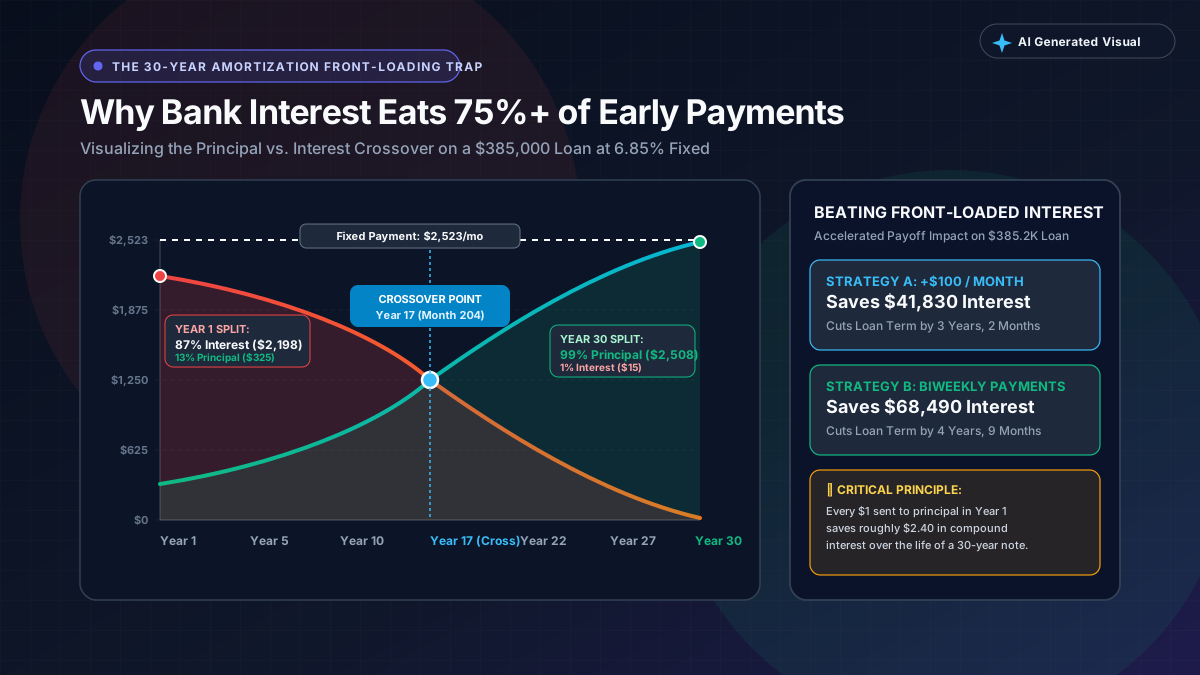
Let us inspect the raw ledger numbers for a $385,200 loan at 6.85% fixed interest:
• Month 1: Total P&I Payment = $2,523. Of this, $2,198.83 goes to Bank Interest, and only $324.17 goes toward Principal reduction. Your remaining loan balance after paying over twenty-five hundred dollars is $384,875.83.
• Month 60 (Year 5): Total P&I Payment = $2,523. Interest = $2,060.45. Principal = $462.55. After 5 full years and $151,380 in payments, you have only paid down $24,240 of your original principal balance.
• Month 204 (Year 17): The Crossover Point! For the first time, Principal ($1,262.10) exceeds Interest ($1,260.90). It takes seventeen years of faithful payments just to reach a 50/50 equity split.
• Month 360 (Final Payment): Interest = $14.32. Principal = $2,508.68. The debt is finally extinguished.
 AI Generated Image
The Mathematical Counter-Attack: Accelerated Principal & Biweekly Payments
Because early interest is calculated against the remaining balance, every extra dollar paid directly toward principal in Year 1 permanently destroys 29 years of compounding interest. Making just one additional mortgage payment per year (or switching to an automated biweekly schedule where you pay half your monthly note every two weeks, generating 26 half-payments = 13 full payments per year) shaves 4.8 years off your loan and saves $68,490 in pure interest on a $385K loan.
5. Debt-to-Income (DTI) Underwriting: The Hidden Rule That Kills Loan Approvals
How an $800 car payment or $400 student loan wipes out $120,000+ of home purchasing power
The critical trap that many buyers fail to recognize is how non-housing debts disproportionately cannibalize borrowing capacity. In a 7% interest rate environment, every $100 per month of recurring non-housing debt eliminates approximately $15,000 to $18,000 of mortgage borrowing capacity. An American buyer carrying an $800/month truck loan and a $400/month student loan payment has eliminated over $180,000 in home purchasing power compared to an identical earner with zero consumer debt.
The matrix below outlines purchasing power limits across common US household salary bands:
- Front-End DTI Ratio (Housing Ratio): The percentage of your gross monthly income devoted strictly to your full housing payment (PITI + HOA). Traditional underwriting guidelines recommend a maximum front-end ratio of 28%.
- Back-End DTI Ratio (Total Debt Ratio): The percentage of your gross monthly income required to pay all recurring monthly debts combined (PITI + minimum credit card payments + auto loans + student loans + personal loans + child support). Traditional conforming guidelines prefer a maximum back-end ratio of 36%, though automated underwriting systems (AUS) will allow up to 43% to 45% for prime borrowers, and FHA loans can occasionally stretch to 50% with strong compensating factors.
| Gross Annual Household Income | Gross Monthly Income | 28% Front-End Max Housing Limit | 36% Back-End Total Debt Limit | Max Mortgage Power (Zero Consumer Debt) | Max Mortgage Power ($900/mo Auto + Student Debt) |
|---|---|---|---|---|---|
| $75,000 / year | $6,250 / mo | $1,750 / month | $2,250 / month | $215,000 home | $130,000 home (-40% capacity) |
| $100,000 / year | $8,333 / mo | $2,333 / month | $3,000 / month | $315,000 home | $210,000 home (-33% capacity) |
| $125,000 / year | $10,417 / mo | $2,917 / month | $3,750 / month | $410,000 home | $295,000 home (-28% capacity) |
| $150,000 / year | $12,500 / mo | $3,500 / month | $4,500 / month | $515,000 home | $390,000 home (-24% capacity) |
| $200,000 / year | $16,667 / mo | $4,667 / month | $6,000 / month | $710,000 home | $575,000 home (-19% capacity) |
6. The 20% Down Payment Myth vs. The Actual Cost of PMI
Why waiting years to avoid Private Mortgage Insurance often costs more than paying it
For decades, conventional personal finance advice has dogmatically preached that homebuyers should never purchase a home without putting 20% down to avoid Private Mortgage Insurance (PMI). In a market where a starter home costs $430,000, 20% down requires $86,000 in liquid cash—plus an additional $12,000 to $15,000 in closing costs and reserve funds.
For young families and first-time buyers earning standard wages, accumulating $100,000 in liquid savings while paying high market rents can take 6 to 9 years. During that multi-year saving period, two economic forces quietly destroy their financial progress: home price inflation and compounding rent expenditure. If home prices rise by a modest 4% annually, a $430,000 home increases in price by $17,200 in Year 1 alone—outpacing the total annual savings of many households.
In reality, Conventional PMI is rarely the financial villain it is made out to be. On a conforming conventional loan, PMI is a private insurance policy that protects the lender in the event of default. For borrowers with credit scores above 720, PMI typically costs between 0.25% and 0.50% of the loan amount annually ($80 to $150 per month on a $350,000 loan).
The Homeowners Protection Act of 1998 (HPA Rights)
Under federal law, your lender must automatically cancel conventional PMI once your principal balance is scheduled to reach 78% of the original purchase value. Furthermore, you have the legal right to request early PMI cancellation as soon as your loan balance hits 80% LTV—or sooner if property appreciation and home improvements push your equity past 20% (verified by a new lender-ordered appraisal).
| Loan Program | Minimum Down Payment | Mortgage Insurance Type | Monthly Cost on $350K Loan | How / When Insurance Drops Off |
|---|---|---|---|---|
| Conventional Conforming | 3.0% (First-time) / 5.0% (Standard) | Private Mortgage Insurance (PMI) | $75 – $145 / month (credit dependent) | Automatically cancelled by law at 78% LTV; can request cancellation at 80% LTV with new appraisal. |
| FHA Loan (Govt Insured) | 3.5% (580+ credit) | Upfront MIP (1.75%) + Annual MIP (0.55%) | $160 / month + $6,125 rolled into loan | PERMANENT for the entire 30-year life of loan if down payment < 10%. Requires a full refinance into conventional to remove. |
| VA Loan (Veterans / Military) | 0.0% Down Payment | None (One-time VA Funding Fee applies) | $0 / month ongoing | No ongoing mortgage insurance ever charged; funding fee can be rolled into financing. |
| USDA Rural Housing | 0.0% Down Payment | 1.0% Upfront Guarantee + 0.35% Annual | $102 / month ongoing | Permanent for the life of the loan; restricted to designated rural/exurban geographic areas. |
7. Mortgage Rate Locks, Discount Points & Break-Even Math
How to mathematically evaluate whether paying upfront points makes financial sense
The critical strategic lesson: if you plan to live in the home for 10 or 15 years and interest rates remain stable, paying points will save you money over the long haul. However, if there is a strong probability you will relocate, sell, or refinance within 3 to 4 years—which describes over 60% of first-time American homebuyers—paying upfront discount points is a complete waste of capital. Never pay points unless you are certain your ownership timeline exceeds the break-even horizon.
Mortgage Discount Points Break-Even Formula
Break-Even Horizon (in Months) = Total Upfront Cash Cost of Points / Monthly Payment Savings Example: If paying $3,600 in points lowers your monthly payment from $2,420 to $2,360 (a $60/month savings): Break-Even Months = $3,600 / $60 = 60 Months (Exactly 5.0 Years).
8. How Using an Independent Mortgage Calculator Transforms Daily Life
Moving from financial anxiety to absolute mathematical certainty in your home search
When you search for a home without an accurate, transparent calculator, the process is emotionally exhausting. You find yourself touring properties that look wonderful in person, only to endure weeks of stress wondering if your offer will be accepted, whether the escrow payment will push you over the edge, or whether an unexpected rate bump before closing will derail your financial security.
When you utilize an independent, zero-tracking mortgage calculator that incorporates complete PITI, state-specific tax rates, insurance estimates, and amortization schedules, your entire relationship with the housing market changes:
1. You Establish an Unbreakable 'Walk-Away Number': You enter open houses knowing your precise maximum monthly comfort ceiling to the exact penny. When an aggressive real estate agent urges you to bid $30,000 higher to win an emotional bidding war, you can calculate the exact $210/month permanent penalty and walk away with total peace of mind.
2. You Protect Household Quality of Life: A home should be a sanctuary of stability, not a financial prison. By modeling true PITI expenses in advance, you ensure your housing payment leaves ample room in your paycheck for emergency savings, retirement contributions (401k/IRA), children's education, family vacations, and the inevitable 1% to 2% annual home maintenance repairs (water heaters, HVAC units, roof maintenance).
3. You Level the Playing Field with Lenders: Loan officers work on commission; their incentive is to qualify you for the highest loan amount the underwriting software will technically permit. Having your own independent numbers allows you to inspect Loan Estimates with a critical eye, challenge inflated closing fees, evaluate whether discount points make mathematical sense, and demand transparency at every step.
The Golden Rule of Home Affordability
Never let a bank tell you how much you can afford. The bank calculates the maximum amount they can lend you while keeping their statistical risk of default within acceptable investor parameters. Only you know what monthly payment allows your family to sleep soundly at night.
Frequently Asked Questions
Click any question below to expand quick answers, formulas, and expert tips.
What is the difference between a 15-year and a 30-year fixed mortgage?
A 15-year fixed mortgage requires substantially higher monthly payments because the loan principal is paid off in half the time. However, 15-year mortgages carry lower interest rates (typically 0.5% to 0.75% below 30-year rates) and save over 60% in lifetime interest charges. A 30-year mortgage offers lower, more manageable monthly payments, giving homeowners vital budget flexibility during economic downturns.
How do extra principal payments shorten loan duration and save interest?
Because mortgage interest is calculated monthly against your remaining loan balance, every extra dollar applied directly to principal immediately reduces the base upon which all future interest is calculated. Paying an extra $100 per month on a $385,000 loan at 6.85% cuts over 3 years off your loan term and saves more than $41,000 in interest.
What credit score is needed to qualify for top conventional mortgage rates?
While conventional conforming loans technically permit credit scores down to 620, securing the most competitive interest rates and lowest private mortgage insurance (PMI) premiums requires a FICO score of 740 to 760 or higher. Borrowers with scores between 620 and 680 often pay 0.5% to 1.0% higher interest rates and triple the PMI rate of prime borrowers.
Can I cancel Private Mortgage Insurance (PMI) early?
Yes, on conventional loans. Under the Homeowners Protection Act, you can formally request written PMI cancellation once your loan balance reaches 80% of the original property value. If home prices in your neighborhood have appreciated significantly, you can also request early cancellation based on current market value by ordering a lender-approved appraisal, typically after maintaining the loan for at least two years.
Why did my monthly mortgage payment increase if I have a fixed-rate loan?
Even though your underlying interest rate and Principal & Interest (P&I) payment remain permanently fixed, your monthly mortgage servicer bill can increase due to rising property taxes or homeowners insurance premiums held in escrow. If local county tax assessments rise or insurance rates jump, your servicer must increase your monthly escrow collection to prevent a deficit.
What is an escrow account and why is it mandatory?
An escrow account is a dedicated holding account managed by your mortgage servicer. Each month, the lender collects 1/12th of your estimated annual property taxes and homeowners insurance along with your principal and interest payment. When taxes and insurance premiums come due, the servicer pays the municipal government and insurance company directly on your behalf to protect their collateral against tax liens and uninsurable losses.
What are mortgage discount points and should I pay them?
Discount points are upfront fees paid to the lender at closing to lower your permanent interest rate. One point equals 1% of the loan amount and typically reduces your rate by 0.25%. Paying points only makes sense if you plan to keep the mortgage past the break-even point (Upfront Cost / Monthly Savings). If you plan to sell or refinance within 3 to 5 years, paying points is generally financially disadvantageous.
What is the difference between pre-qualification and pre-approval?
Pre-qualification is an informal estimate based on self-reported financial data with no verification. Pre-approval is a formal, underwritten review where the lender pulls your credit, verifies tax returns, W-2s, bank statements, and pay stubs, and issues an official pre-approval letter stating the precise loan amount you qualify for. Sellers in competitive US markets will rarely review offers without a verified pre-approval letter.
How does a biweekly mortgage payment schedule work?
In a biweekly mortgage schedule, you pay half of your monthly mortgage payment every two weeks. Because there are 52 weeks in a year, you make 26 half-payments, which equals 13 full monthly payments each year instead of 12. That extra payment goes directly toward principal reduction, cutting roughly 4 to 5 years off a 30-year mortgage and saving tens of thousands of dollars in interest.
The Bottom Line
A home is likely the largest financial investment you will ever make. Never let listing portals, loan officers, or real estate agents dictate what you can comfortably afford based on partial P&I numbers. Master your true PITI obligations, verify local county property tax millage rates, understand the front-loaded amortization curve, and use Homecalpro's free, zero-tracking Mortgage Calculator to model your numbers with absolute mathematical certainty.
This article is for informational and educational purposes. Always verify complex calculations with a qualified professional or official documentation.