Body Mass Index (BMI) is the most widely utilized screening tool in clinical medicine, epidemiology, and public health for classifying weight categories and assessing potential metabolic health risks.
First developed in the 1830s by Belgian statistician Adolphe Quetelet, BMI provides an accessible, non-invasive metric to evaluate whether an individual's weight is proportional to their height. This guide covers how to compute BMI accurately, understand clinical charts, recognize its physiological limitations, and utilize complementary health metrics.
Quick answer:BMI is calculated by dividing your weight in kilograms by your height in meters squared: BMI = kg / m². In US units (pounds and inches), the formula is: BMI = (weight in lbs × 703) / (height in inches)². A BMI between 18.5 and 24.9 is classified as normal healthy weight by the World Health Organization.
The Mathematical Formulas for BMI (Metric and US Customary)
BMI standardizes body weight relative to surface area scaling. There are two standard formulas depending on which unit system you use:
- Metric Formula: BMI = Weight (kg) ÷ [Height (m)]²
- Imperial (US) Formula: BMI = [Weight (lbs) × 703] ÷ [Height (inches)]²
- Where 703 is the imperial conversion factor converting pounds per square inch into kilograms per square meter.
Step-by-Step Manual Calculation Walkthrough
Let's calculate the BMI for an adult who is 5 feet 10 inches tall and weighs 170 pounds:
1. Convert Height to Total Inches: 5 ft × 12 in/ft = 60 inches + 10 inches = 70 inches.
2. Square the Height: 70 × 70 = 4,900 square inches.
3. Multiply Weight by 703: 170 × 703 = 119,510.
4. Divide by Squared Height: 119,510 ÷ 4,900 = 24.39.
Result: A BMI of **24.4**, which falls squarely within the healthy 'Normal Weight' range.
World Health Organization (WHO) BMI Classification Table
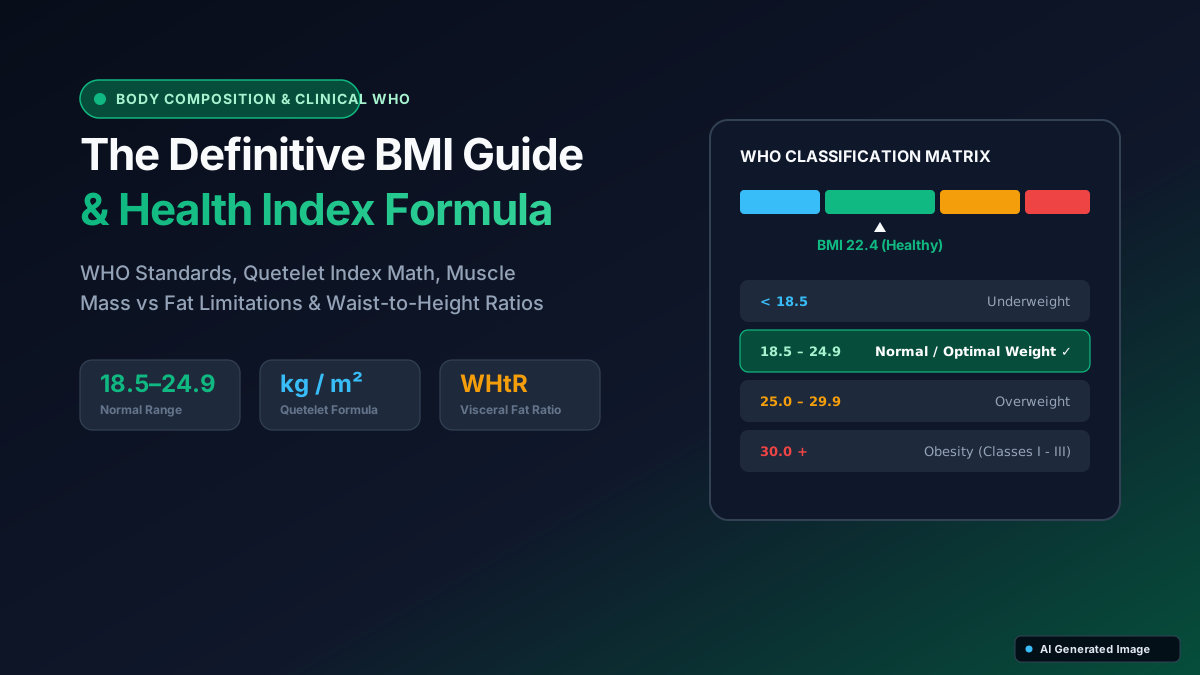
The World Health Organization (WHO) and Centers for Disease Control and Prevention (CDC) establish standard BMI brackets for adults aged 20 and older:
| BMI Range | WHO Weight Classification | Associated Health & Metabolic Risk | Recommended Action |
|---|---|---|---|
| Below 18.5 | Underweight | Increased risk of nutritional deficiency, osteopenia, anemia | Consult healthcare provider on balanced caloric intake |
| 18.5 – 24.9 | Normal / Healthy Weight | Lowest statistical risk for cardiovascular disease & type 2 diabetes | Maintain balanced diet and regular physical activity |
| 25.0 – 29.9 | Overweight | Moderate elevation in cardiovascular and joint strain risk | Focus on nutrient-dense foods and strength/cardio exercise |
| 30.0 – 34.9 | Obese Class I (Moderate) | High risk for hypertension, dyslipidemia, insulin resistance | Consult physician for personalized lifestyle guidance |
| 35.0 – 39.9 | Obese Class II (Severe) | Very high risk of chronic cardiometabolic complications | Comprehensive medical and nutritional evaluation |
| 40.0 and Above | Obese Class III (Very Severe) | Extremely high risk of clinical morbidity | Clinical intervention and supervised medical management |
Limitations of BMI: Why It Does Not Tell the Whole Story
While BMI is an excellent population-level screening tool, it has notable physiological limitations when applied to individual assessment:
1. **Does Not Differentiate Muscle from Fat**: Muscle tissue is approximately 18% denser than adipose fat tissue. Muscular athletes, bodybuilders, and weightlifters often have BMIs over 28 or 30 despite having exceptionally low body fat percentages (8–12%) and superior cardiovascular health.
2. **Does Not Account for Fat Distribution**: Visceral fat (fat stored around internal organs in the abdominal cavity) is metabolically dangerous, whereas subcutaneous fat (under the skin) carries significantly lower risk. Two individuals with an identical 26.0 BMI can have completely different cardiovascular risk profiles.
3. **Age-Related Muscle Loss (Sarcopenia)**: As adults age, they naturally lose muscle mass and gain adipose tissue. An elderly person might maintain a 'normal' BMI of 22.0 while carrying unhealthy levels of body fat and inadequate muscle.
4. **Ethnic Differences**: Clinical research demonstrates that populations of South Asian, East Asian, and Pacific Islander descent experience elevated diabetes and cardiovascular risks at lower BMI thresholds. The WHO recommends a lower overweight threshold of **23.0** and obesity cutoff of **27.5** for Asian populations.
Superior Complementary Metrics: Waist-to-Height Ratio (WHtR)
To compensate for BMI's limitations, health organizations increasingly recommend combining BMI with **Waist-to-Height Ratio (WHtR)**:
To measure WHtR, measure your waist circumference at the midpoint between your lowest rib and the top of your hip bone (usually near the navel), and divide by your height. A general rule of thumb is to **keep your waist circumference to less than half your height (WHtR < 0.50)**.
A WHtR under 0.50 indicates low central visceral fat accumulation regardless of your overall body weight or muscular build.
Frequently Asked Questions
Click any question below to expand quick answers, formulas, and expert tips.
Is BMI calculated differently for men and women?
The mathematical formula for adult BMI is identical for both biological sexes. However, women naturally carry higher essential body fat percentages (21–33%) than men (8–20%) at the same numerical BMI.
How is BMI calculated for children and teenagers?
For children and teens aged 2 to 19, BMI is calculated using the same formula but interpreted as a BMI Percentile compared to CDC age-and-sex-specific growth charts, because body composition changes rapidly during growth spurts.
Can I lower my BMI without losing muscle?
Yes, by adopting a moderate calorie deficit (300–500 kcal/day), consuming high dietary protein (0.7–1.0g per pound of body weight), and performing resistance strength training 3–4 days per week.
The Bottom Line
BMI is a quick, helpful screening baseline. To check your BMI and ideal body weight category in US or Metric units, use our free instant client-side BMI Calculator.
This article is for informational and educational purposes. Always verify complex calculations with a qualified professional or official documentation.