If you earn $100,000 a year and you are thinking about buying a home, one question comes before everything else: how much house can I actually afford? Not the number a lender might approve, and not the number a real estate listing site hints at, but the number that lets you pay the mortgage, keep saving, and still enjoy life.
This guide walks through the exact math. You will see how lenders look at your income, how the popular 28/36 rule works, what a $100,000 salary realistically buys at different down payments and interest rates, and which hidden costs push a payment higher than most buyers expect.
Quick answer:On a $100,000 salary with moderate debts, most buyers can comfortably afford a home priced between roughly $300,000 and $375,000, depending on down payment, interest rate, property taxes, and existing monthly debts.
Why 'What Will the Bank Approve?' Is the Wrong Question
Lenders will often approve you for more than you should spend. Approval is based on ratios and risk models, not on your lifestyle, your savings goals, or your childcare costs. Being 'approved' for a payment that takes half of your take-home pay can leave you house-rich and cash-poor.
A better approach is to work out three numbers: 1. The maximum a lender is likely to allow (the ceiling). 2. The amount that fits a healthy budget (the target). 3. The amount you are personally comfortable paying every month (the real limit).
Step 1: Start With Your Gross Monthly Income
Lenders begin with your gross income, which is your income before taxes and deductions:
• Annual salary: $100,000
• Gross monthly income: $100,000 ÷ 12 = $8,333
Step 2: Apply the 28/36 Rule
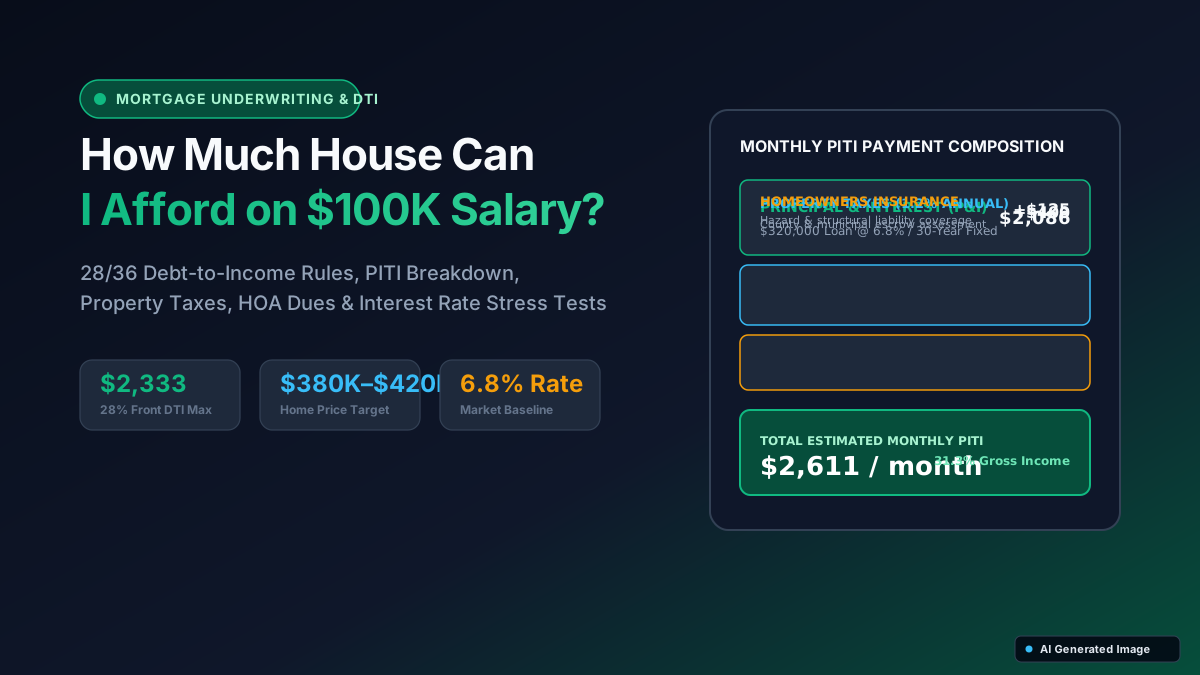
The 28/36 rule is the most widely used guideline for mortgage affordability. It has two parts:
The front-end ratio (28%): Your total monthly housing cost should not exceed about 28% of your gross monthly income ($8,333 × 0.28 = $2,333/month).
The back-end ratio (36%): Your total monthly debt payments, including the new housing payment plus car loans, student loans, and credit card minimums, should not exceed about 36% of your gross monthly income ($8,333 × 0.36 = $3,000/month).
| Ratio Rule | Calculation Math | Monthly Dollar Limit |
|---|---|---|
| Front-End Ratio (28%) | $8,333 × 0.28 | $2,333 / month |
| Back-End Ratio (36%) | $8,333 × 0.36 | $3,000 / month (total debt) |
Step 3: Down Payment and Interest Rate Scenarios
Interest rates and down payments dramatically swing your purchasing power on a fixed $2,333 monthly budget:
• Scenario A (10% Down Payment at 6.5% interest): Supports a home purchase price of roughly **$317,000** (with PMI required).
• Scenario B (20% Down Payment at 6.5% interest): Supports a home purchase price of roughly **$372,000** (with no PMI).
Putting 20% down increases your home buying power by approximately $55,000 at the exact same monthly payment.
Frequently Asked Questions
Click any question below to expand quick answers, formulas, and expert tips.
Can I afford a $400,000 house on a $100,000 salary?
It is possible but tight for many buyers. A $400,000 home with 20% down, a 6.5% rate, and typical taxes and insurance produces a payment of roughly $2,500, which exceeds the 28% guideline. You would likely need a larger down payment, a lower rate, lower taxes, or additional income to make it comfortable.
What credit score do I need to buy a house?
Conventional loans commonly require a minimum score around 620, and FHA loans can accept lower scores with a larger down payment. A higher score qualifies you for better rates, which directly increases how much house you can afford.
Is the 28/36 rule still realistic in expensive cities?
In high-cost areas, many buyers exceed 28% to buy at all. Lenders may allow it, but your monthly flexibility shrinks. If you stretch beyond the guideline, build a larger emergency fund and keep other debt low.
Should I include my spouse's income?
If you apply together, lenders combine both incomes and both sets of debts. A second income can raise your buying power considerably, but remember that your plan should still work if one income changes.
The Bottom Line
On a $100,000 salary, a realistic home budget for many buyers is between $300,000 and $375,000. Run your real numbers in our free Mortgage Affordability Calculator.
This article is for informational and educational purposes. Always verify complex calculations with a qualified professional or official documentation.