Planning to pour a concrete slab for a backyard patio, workshop shed, hot tub, or detached garage extension? A properly poured concrete slab is one of the most durable, value-accretive structural upgrades you can make to residential property. However, it is also one of the easiest home improvement projects to accidentally overspend on—or worse, ruin during subgrade preparation.
Between regional cement batch plant price increases, ready-mix transit surcharges, rising commercial fuel minimums, and local labor rates, quoting concrete in 2026 requires far more precision than a generic length-times-width estimate. If you under-order by even half a cubic yard, you trigger a mid-pour emergency stop; if you guess on slab thickness without accounting for vehicle axle weights, your investment will shear and crack within two freeze-thaw cycles.
This definitive, contractor-backed guide unpacks the true mathematics and economics of concrete slabs in 2026. You will learn the exact square-foot cost breakdown across all common dimensions, the verified geometric formula contractors use to calculate exact cubic yards and bags, the tipping point between bagged concrete and ready-mix trucks, and the six hidden line-item fees that routinely derail homeowner budgets.
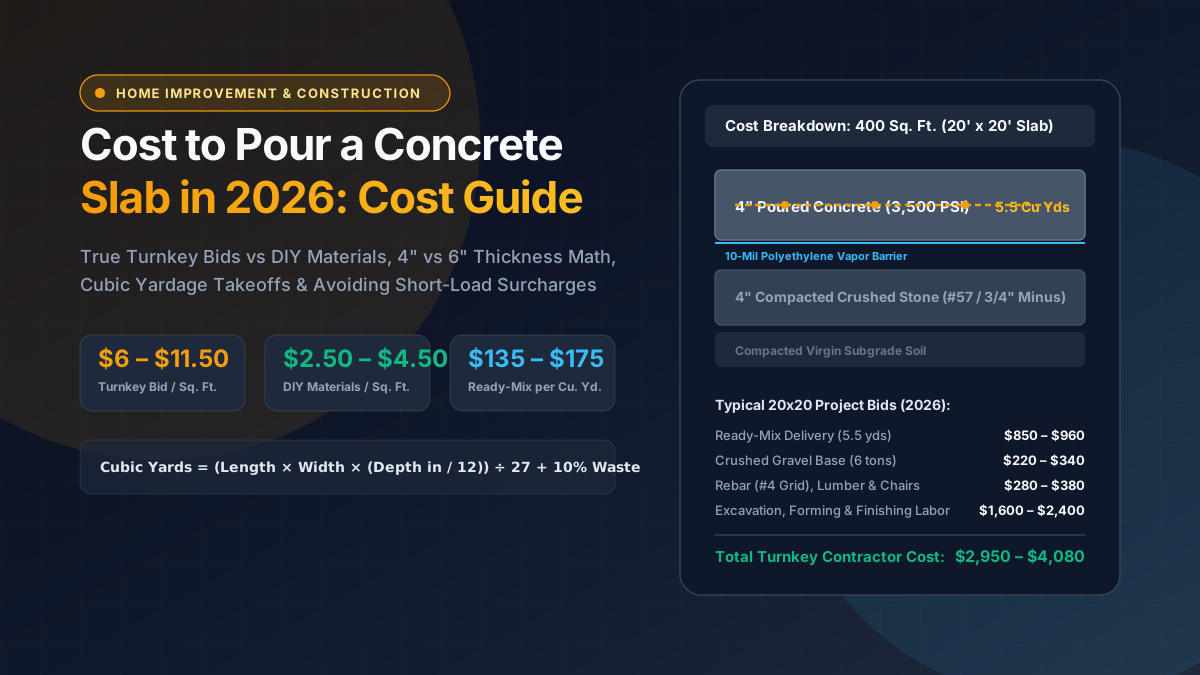
Quick answer:In 2026, the national average turnkey cost to have a professional contractor pour a standard 4-inch residential concrete slab is between $6.00 and $11.50 per square foot, including excavation, crushed stone sub-base, formwork, rebar/mesh reinforcement, concrete delivery, and finishing. For a standard 20 ft × 20 ft (400 sq. ft.) patio or garage slab, turnkey installation averages $2,800 to $4,600. If you complete the excavation, forming, and finishing yourself (DIY), materials cost between $2.50 and $4.50 per square foot ($1,000 to $1,800 for a 20x20 slab). Ready-mix concrete delivery costs between $135 and $175 per cubic yard, with most batch plants assessing a $50 to $150 short-load fee on orders under 4 or 5 cubic yards. Always add a 10% waste buffer to your theoretical volume calculation: Cubic Yards = (Length ft × Width ft × (Thickness in ÷ 12)) ÷ 27 × 1.10.
1. 2026 Concrete Slab Cost Benchmarks: Turnkey Contractor vs. DIY
National average pricing per square foot across common residential project sizes
Across the United States, the national average cost to pour a standard 4-inch residential concrete slab ranges between $6.00 and $11.50 per square foot when hiring a licensed concrete contractor. This turnkey rate covers site excavation, 4 inches of crushed stone sub-base, formwork erection, rebar or welded wire reinforcement, ready-mix dispatch delivery, pouring, screeding, bull-floating, and a slip-resistant broom finish.
If you elect the DIY route and manage site preparation, forming, pouring, and finishing yourself, raw material expenses fall between $2.50 and $4.50 per square foot. However, DIYers assume 100% financial and physical liability for subgrade compaction, formwork blowout bracing, and rapid chemical set times. The table below outlines real-world 2026 project cost ranges for standard residential slab dimensions.
The Scale Economy of Concrete Slabs
Notice that smaller slabs (under 100 sq. ft.) cost significantly more per square foot ($10 – $15/sq. ft.) than large garage slabs ($6 – $8/sq. ft.). This is because contractors incur fixed overhead costs for mobilizing excavation machinery, setting laser grades, and paying ready-mix dispatch minimums regardless of slab size.
| Slab Dimension | Total Area (Sq. Ft.) | Typical Application | DIY Materials Cost Range | Turnkey Contractor Bid Range |
|---|---|---|---|---|
| 8 ft × 10 ft | 80 sq. ft. | Garden Tool Shed / Trash Pad | $220 – $360 | $650 – $1,100 |
| 10 ft × 10 ft | 100 sq. ft. | Bistro Patio / Generator Pad | $280 – $450 | $750 – $1,300 |
| 12 ft × 12 ft | 144 sq. ft. | Backyard Dining Patio | $400 – $650 | $1,100 – $1,800 |
| 12 ft × 20 ft | 240 sq. ft. | Single-Car Carport / Workshop | $680 – $1,050 | $1,750 – $2,800 |
| 16 ft × 24 ft | 384 sq. ft. | Detached 1.5-Car Garage | $1,100 – $1,700 | $2,700 – $4,400 |
| 20 ft × 20 ft | 400 sq. ft. | Standard 2-Car Garage Slab | $1,150 – $1,800 | $2,900 – $4,800 |
| 24 ft × 24 ft | 576 sq. ft. | Spacious 2-Car Garage / RV Pad | $1,650 – $2,600 | $4,100 – $6,600 |
| 30 ft × 40 ft | 1,200 sq. ft. | Commercial Workshop / Barndominium | $3,500 – $5,400 | $8,500 – $14,000 |
2. 4-Inch vs. 6-Inch Slabs: Engineering Depth & Structural Load
Why choosing the wrong thickness leads to premature shear failure and cracking
One of the most consequential decisions in any flatwork project is determining the slab thickness. Once concrete is poured and cured, it cannot be structurally thickened or reinforced from beneath.
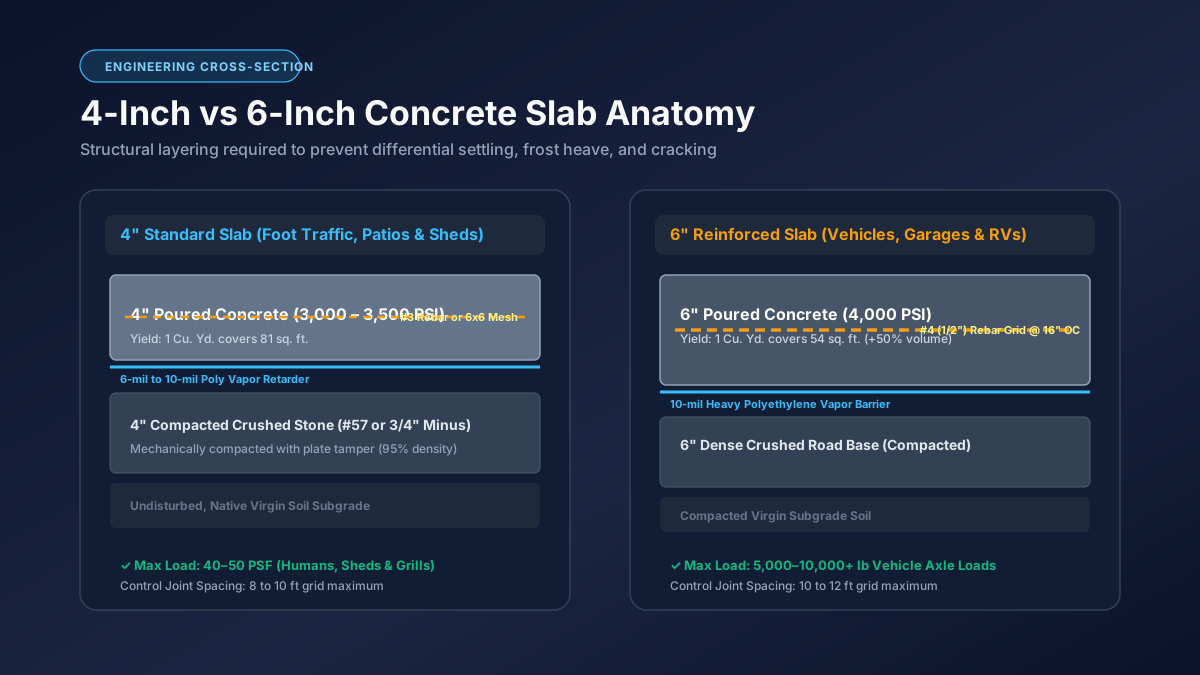
A nominal 4-inch slab (framed with standard 2x4 lumber, which measures 3.5 inches tall) is the engineered baseline for human foot traffic, outdoor patio furniture, barbecue grills, and small detached outbuildings weighing under 1,500 pounds.
Whenever a slab will support motorized vehicles, pickup trucks, utility trailers, campers, heavy ride-on tractors, or two-post automotive shop lifts, the slab must be upgraded to a true 5-inch or 6-inch thickness framed with 2x6 lumber and reinforced with #4 (1/2-inch) rebar.
 AI Generated Image
The Cost-to-Volume Rule
Upgrading from 4 inches to 6 inches increases your concrete volume by 50%, but increases your total project cost by only 18% to 25%. Excavation, gravel grading, framing lumber, and finishing labor are virtually identical. If you think you might park a truck, camper, or heavy tool chest on the slab in the future, pour 6 inches now.
| Specification Metric | Standard 4-Inch Slab | Heavy-Duty 6-Inch Slab |
|---|---|---|
| Framing Lumber | 2x4 Dimensional Lumber (3.5" true depth) | 2x6 Dimensional Lumber (5.5" true depth) |
| Concrete Volume Multiplier | 1.00x Baseline (1 cu. yd. = 81 sq. ft.) | 1.50x (+50% more concrete volume) |
| Primary Reinforcement | 6x6 Welded Wire Mesh or #3 (3/8") Rebar | #4 (1/2") Deformed Rebar Grid @ 16" OC |
| Compressive Strength | 3,000 to 3,500 PSI Mix | 4,000 to 4,500 PSI High-Early Mix |
| Crushed Stone Base | 4" Compacted 3/4" Minus Gravel | 6" Compacted Dense Road Base |
| Recommended Applications | Patios, walkways, hot tub pads, sheds | Driveways, garages, RV pads, shop lifts |
3. The Contractor Cubic Yardage Formula & 10% Waste Rule
How to calculate exact material volume and avoid costly dispatch shortages
Let us walk through a real-world calculation for a standard 24 ft × 24 ft detached 2-car garage slab poured at 4 inches thick:
Step 1: Calculate total surface area: 24 ft × 24 ft = 576 square feet.
Step 2: Multiply by thickness in feet: 576 sq. ft. × (4 ÷ 12) = 192 cubic feet.
Step 3: Convert to cubic yards: 192 cu. ft. ÷ 27 = 7.11 cubic yards.
Never order the exact theoretical volume! Soil excavation is never laser-flat, form boards flex outward under thousands of pounds of hydrostatic pressure, and crushed gravel sub-bases have minor low spots. Professional concrete finishers always add a mandatory 10% waste buffer (15% on sloped or uneven ground).
For our 24x24 slab: 7.11 cubic yards × 1.10 = 7.82 cubic yards. You would round up and order exactly 8.0 cubic yards from the ready-mix batch plant.
Standard Cubic Yardage Equation
Cubic Yards = [Length (ft) × Width (ft) × (Thickness (in) ÷ 12)] ÷ 27
4. Ready-Mix Truck vs. Bagged Pre-Mix: The 1.5 Cubic Yard Tipping Point
Comparing material pricing, physical labor, and batch plant minimum charges
Homeowners frequently debate whether to buy 80-pound pre-mixed bags (such as Quikrete or Sakrete) from The Home Depot or Lowe's, or to schedule a commercial ready-mix transit mixer truck.
The definitive economic and physical tipping point is 1.5 cubic yards (approximately 120 square feet at 4 inches thick). Anything smaller than 1.5 cubic yards makes sense for bags; anything larger demands a ready-mix truck.
- Bag Yield Mathematics: One standard 80-lb bag of pre-mixed concrete yields approximately 0.60 cubic feet. Because 1 cubic yard equals 27 cubic feet, it requires exactly 45 bags of 80-lb concrete (or 60 bags of 60-lb concrete) to produce just ONE cubic yard.
- Bag Material Cost: At roughly $6.50 per 80-lb bag, one cubic yard of bagged concrete costs approximately $292 in materials alone—significantly higher than ready-mix delivery.
- Physical Labor Reality: A 20 ft × 20 ft patio slab requires roughly 5.5 cubic yards. That equals 248 bags of 80-lb concrete weighing nearly 20,000 pounds (10 tons). Mixing 248 bags by hand or small electric drum mixer under the scorching sun before the first batch begins setting is virtually impossible for a DIY crew.
- Ready-Mix Delivery Rates: Commercial ready-mix currently averages $135 to $175 per cubic yard. A transit mixer backs up, extends its chute, and empties 6 cubic yards in under 15 minutes with laboratory-certified water-cement consistency.
- Beware the Short-Load Fee: Ready-mix trucks are designed to haul 9 to 11 cubic yards. If you order under 4 or 5 cubic yards, batch plants routinely assess a 'short-load fee' of $50 to $150 per undelivered yard. When ordering 3 cubic yards, factor in this surcharge.
5. Turnkey Line-Item Cost Architecture: Where Contractor Dollars Go
Detailed component-by-component breakdown of a professional concrete flatwork bid
When you review a formal bid from a licensed concrete contractor, understanding where each dollar is allocated prevents you from falling for lowball bids that omit critical structural elements:
1. Site Excavation & Grading ($1.00 – $2.50 per sq. ft.): Removing topsoil, organic matter, and roots down to virgin subgrade soil using a skid-steer loader (Bobcat) or mini-excavator.
2. Crushed Aggregate Sub-Base ($0.80 – $1.75 per sq. ft.): Concrete must never be poured directly onto bare clay or dirt. A minimum 4-inch layer of crushed stone (such as #57 limestone or 3/4-inch minus road base) provides unyielding support, eliminates frost heave voids, and facilitates storm drainage.
3. Formwork Lumber & Bracing ($0.40 – $0.90 per sq. ft.): Straight 2x4 or 2x6 construction spruce framing pinned securely with wooden stakes every 2 to 3 feet to prevent bowing under hydraulic concrete pressure.
4. Structural Reinforcement ($0.50 – $1.20 per sq. ft.): Welded wire fabric (6x6 W1.4/W1.4) or Grade 60 #4 rebar tied into an intersecting grid. Crucially, reinforcement must be elevated on 2-inch plastic rebar chairs rather than resting on the gravel.
5. Ready-Mix Concrete Mud ($1.65 – $2.20 per sq. ft.): The raw delivered material from the certified batch plant, including sales tax and environmental wash-out disposal fees.
6. Skilled Finishing Labor ($2.50 – $5.50 per sq. ft.): The physical art of screeding the surface flat, bull-floating aggregate downward, hand-troweling edges, grooving expansion joints, and brushing on a clean, slip-resistant broom texture.
6. Six Hidden Expenses That Catch Homeowners Off Guard
Critical auxiliary line items that are rarely included on the initial rough quote
Before authorizing work or setting your personal project budget, ensure you have accounted for these six frequently overlooked auxiliary expenses:
- Concrete Pump Truck Rental ($600 – $1,200): A fully loaded concrete truck weighs over 65,000 pounds (32+ tons). If your backyard lacks 10-foot gate clearance, or driving a 32-ton vehicle across your driveway risks crushing underground sewer pipes or puncturing a septic drain field, you cannot chute directly. You must rent a trailer ground-line pump or hydraulic boom pump truck.
- Old Concrete Demolition & Haul-Away ($2.00 – $4.50 per sq. ft.): Breaking up an old cracked patio with a jackhammer, hauling away 4 to 8 tons of rubble, and paying municipal dump transfer fees can quickly add $800 to $2,000 to a remodel.
- Vapor Barrier Retarder ($0.25 – $0.50 per sq. ft.): For garage slabs, workshops, or enclosed living areas, a 10-mil to 15-mil continuous polyethylene vapor retarder must be laid over the gravel base to prevent ground moisture from rising through the slab and ruining future flooring.
- Municipal Building Permits ($75 – $350): Most US municipalities require building permits and zoning setbacks for permanent flatwork exceeding 100 square feet to regulate stormwater impervious surface calculations.
- Penetrating Chemical Sealers ($0.40 – $0.85 per sq. ft.): Applying a silane-siloxane penetrating sealer 28 days post-pour shields the slab against de-icing salt pitting, oil staining, and winter freeze-thaw spalling.
- Hot / Cold Weather Admixtures ($5 – $10 per cubic yard): Pouring during 90°F+ summer days requires chemical hydration retarders to prevent flash-setting; pouring in sub-40°F weather requires non-chloride accelerants so the water does not freeze before setting.
7. Step-by-Step Quality Execution: Pour Day Checkpoints
How to inspect work in real-time and ensure your slab lasts 30+ years
Whether you are overseeing a hired contractor or tackling the pour with friends, strict adherence to these field checkpoints guarantees structural longevity:
- Drainage Slope Pitch: Exterior slabs must pitch away from your home's foundation at a minimum rate of 1/4 inch per linear foot (or 1 inch of fall every 4 feet). Water pooling against your foundation siding will rot framing and cause basement flooding.
- Verify Rebar Elevation: Rebar lying flat on the gravel base provides zero structural reinforcement. Walk the forms before the truck starts pouring: every stick of rebar must be suspended in the middle third of the slab depth using plastic rebar chairs or masonry adobes.
- Never Add Too Much Water: Ready-mix drivers carry on-board water tanks. Inexperienced crews frequently beg the driver to add extra gallons of water to make the concrete soupy and easier to rake. Resist this temptation: adding just 1 extra gallon of water per cubic yard slashes compressive strength by up to 1,000 PSI and causes severe surface dusting and spider-web shrinkage cracking.
- Control Joint Spacing Rule: Uncontrolled concrete cracks. Control joints (cut grooves) must be spaced at intervals no greater than 24 to 30 times the slab thickness in inches. For a 4-inch slab, cut grooves in a grid no larger than 8 ft × 8 ft to 10 ft × 10 ft.
- Moist Curing Protocol: Concrete does not 'dry'—it cures through chemical hydration. Keeping the slab damp by spraying it with water twice daily or covering it with plastic sheeting for 7 days post-pour increases final surface hardness and strength by over 50%.
8. The DIY vs. Contractor Decision Matrix: Which Path Should You Choose?
A frank, realistic appraisal of risk, liability, and required skill level
Unlike carpentry, tiling, or painting, concrete flatwork cannot be paused, disassembled, or fixed the next morning if something goes wrong. Once the transit mixer discharges its load, you have roughly 60 to 90 minutes to place, screed, float, edge, and broom the entire mass before chemical setting begins.
| Project Criteria | Safe to DIY (Experienced Homeowner) | Hire a Licensed Concrete Contractor |
|---|---|---|
| Surface Area | Under 150 sq. ft. (Small patio, shed, trash pad) | Over 150 sq. ft. (Garages, driveways, large patios) |
| Structural Duty | Human foot traffic, patio chairs, trash cans | Vehicles, trucks, RVs, living quarters, structural loads |
| Site Topography | Flat, level ground with easy wheelbarrow access | Sloped terrain requiring stepped forms or retaining walls |
| Available Crew | At least 3 capable, hard-working adults on pour day | Solo or only one helper available |
| Surface Finish | Simple broom finish or smooth trowel | Decorative stamped concrete, exposed aggregate, or color |
Frequently Asked Questions
Click any question below to expand quick answers, formulas, and expert tips.
How much does a 24x24 concrete slab cost in 2026?
A standard 24 ft × 24 ft (576 sq. ft.) concrete slab costs an average of $4,100 to $6,600 for turnkey professional installation ($7 to $11.50 per sq. ft.). If poured at 4 inches thick with a 10% waste buffer, it requires approximately 7.8 to 8.0 cubic yards of ready-mix concrete. If you tackle the project as a DIY build, materials (ready-mix delivery, gravel base, rebar, lumber, and chairs) cost roughly $1,650 to $2,600.
How many bags of 80 lb concrete do I need for 1 cubic yard?
You need exactly 45 bags of 80-pound concrete to yield one cubic yard (27 cubic feet), because each 80-lb bag yields approximately 0.60 cubic feet. If using 60-pound bags, you will need 60 bags per cubic yard. For 50-pound bags, you will need 72 bags per cubic yard.
What is the minimum thickness for a residential concrete slab?
The absolute minimum thickness for a residential slab is 3.5 to 4 inches (typically framed using 2x4 lumber). This thickness is engineered exclusively for human foot traffic, garden sheds, hot tubs, and patio furniture. Any slab that will bear vehicular traffic (cars, pickup trucks, RVs) or heavy machinery must be poured at a minimum thickness of 5 to 6 inches.
How long before I can walk on and park vehicles on a new concrete slab?
You can safely walk on a newly poured slab after 24 to 48 hours. Heavy patio furniture and grills can be placed after 7 days. Motor vehicles, pickup trucks, and RVs must stay off the slab for a minimum of 28 days, which is the standard chemical hydration duration required for concrete to reach 98% of its rated design compressive strength (PSI).
Why do contractors cut grooves (control joints) into fresh concrete?
All concrete shrinks slightly as water evaporates during hydration (about 1/16 inch per 10 linear feet). Control joints do not stop shrinkage; they create predetermined weakened vertical planes so that when the concrete inevitably cracks, it fractures cleanly inside the hidden groove rather than forming an unsightly spider-web across the decorative surface.
What is a concrete short-load fee and how do I avoid it?
A short-load fee is a dispatch surcharge (typically $50 to $150 per yard) levied by ready-mix plants when a customer orders less than a truck's minimum capacity threshold (commonly 4 or 5 cubic yards). To avoid or minimize this fee, combine projects (such as pouring a walkway, air conditioner pad, or trash can slab on the same day) to reach the plant's minimum order threshold.
The Bottom Line
A turnkey residential concrete slab in 2026 costs between $6.00 and $11.50 per square foot, while DIY materials cost $2.50 to $4.50. Calculate your precise cubic yards, ready-mix trucks, bagged equivalents, and material costs in seconds using the free HomeCalPro Concrete Slab Calculator.
This article is for informational and educational purposes. Always verify complex calculations with a qualified professional or official documentation.
Authoritative References & Government Sources
Verify mortgage underwriting guidelines, rate statistics, and tax rules from official regulatory agencies.
- ASTM C94 / C94M-23: Standard Specification for Ready-Mixed Concrete
Official engineering standards governing transit-mixed concrete batching, slump tolerances, and dispatch times.
- American Concrete Institute (ACI) 302.1R: Guide for Concrete Floor and Slab Construction
Definitive industry guidelines for residential and commercial subgrade compaction, joint spacing, and curing protocols.
- U.S. Bureau of Labor Statistics (BLS): Cement Masons and Concrete Finishers Wage & Cost Data
Federal employment, regional hourly wage rates, and commercial installation cost benchmarks.